
Ramaphosa and Mnangagwa Sign New South Africa-Zimbabwe Trade Agreements
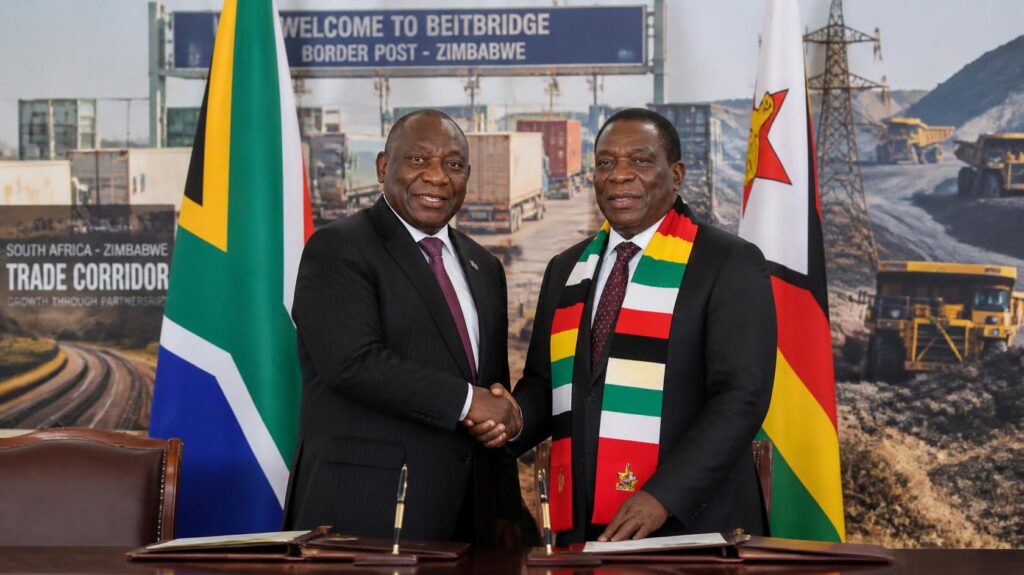
President Cyril Ramaphosa and Zimbabwean President Emmerson Mnangagwa have concluded the fourth South Africa–Zimbabwe Bi-National Commission in Pretoria with new agreements and memoranda of understanding aimed at deepening economic cooperation between the neighbouring countries.
The fresh development came on Friday, 21 August 2026, after the two leaders and their ministerial delegations reviewed bilateral relations at the OR Tambo Building.
Ramaphosa confirmed that agreements and memoranda of understanding were signed in the presence of the two presidents, saying the focus must now shift from political commitments to implementation.
The outcome materially advances the story from this morning, when the commission was still under way.
Trade between South Africa and Zimbabwe has almost doubled
Ramaphosa said bilateral trade between the two countries has almost doubled over the past four years, reinforcing Zimbabwe’s position as one of South Africa’s largest trading partners.
However, he acknowledged a significant imbalance.
South Africa currently exports substantially more goods to Zimbabwe than it imports from its northern neighbour.
The two governments have agreed that future cooperation should focus not only on increasing the volume of trade but also on creating a more balanced commercial relationship.
Ramaphosa said instruments including a memorandum on economic cooperation should be used to reduce the trade deficit and expand production on both sides of the border.
Mining, energy and agriculture identified as major opportunities
The two governments identified a broad range of sectors where cooperation could be expanded.
These include agriculture and agro-processing, energy, mining, transport, medicines and vaccines, water, tourism, finance and digital technology.
Mining is expected to feature prominently.
Zimbabwe has significant gold, platinum and lithium resources, while South Africa has been pushing for greater mineral beneficiation and domestic processing.
Ramaphosa said both countries should move away from simply exporting raw natural resources and instead create more value and employment by processing minerals within the region.
That approach also aligns with wider Southern African efforts to build regional industrial value chains.
Beitbridge and Musina cooperation in focus
Border management emerged as another major priority.
South Africa and Zimbabwe share one of the busiest land-border relationships on the continent, with large volumes of people, commercial vehicles and goods moving through Beitbridge every year.
Ramaphosa said the two countries had committed to making the movement of people and goods more seamless and secure, while improving coordination between their authorities.
The presidents also highlighted water cooperation.
One existing agreement involves supplying water from Zimbabwe’s Beitbridge Water Works to Musina in Limpopo, which Ramaphosa cited as an example of how cross-border cooperation can directly improve services for communities.
Governments target cross-border organised crime
Security was also placed firmly on the bilateral agenda.
Ramaphosa said South Africa and Zimbabwe would strengthen cooperation against cross-border and transnational organised crime.
The two countries face shared challenges involving smuggling, trafficking, illegal border crossings and other forms of organised criminal activity operating across national boundaries.
The commitment could result in closer coordination between police, border-management authorities and other security agencies.
Ramaphosa said safe communities and effectively managed borders were essential to the countries’ wider economic ambitions.
Infrastructure investment could accelerate
Infrastructure development was another major focus of Friday’s talks.
Ramaphosa said South Africa and Zimbabwe need greater investment in roads, bridges, dams, airports, health facilities and schools if regional trade and economic growth are to expand.
He pointed to institutions including the Development Bank of Southern Africa and Industrial Development Corporation as potential investors in high-impact Zimbabwean infrastructure projects.
Better infrastructure between the countries could strengthen regional transport corridors and improve access between farms, factories, mines and export markets.
It could also support the implementation of the African Continental Free Trade Area.
Energy cooperation takes on growing importance
South Africa and Zimbabwe also want to deepen cooperation in electricity generation and regional energy trading.
Both participate in the Southern African Power Pool, which allows countries in the region to buy and sell electricity across borders.
Ramaphosa said the countries should use the regional power system to develop more clean, affordable and reliable energy.
Energy security remains a major economic issue across Southern Africa, making increased investment in generation and transmission infrastructure particularly important.
Regional conflicts also discussed
The talks extended beyond bilateral economic issues.
Ramaphosa raised concern over instability in eastern Democratic Republic of Congo, Cabo Delgado in Mozambique, Madagascar, Sudan, South Sudan and the Sahel.
He argued that worsening international instability makes regional cooperation and peaceful conflict resolution increasingly important.
South Africa also congratulated Zimbabwe on its election to a non-permanent seat on the United Nations Security Council for the 2027–2028 term.
Agreements now face implementation test
The exact value of Friday’s summit will ultimately depend on how quickly the commitments are implemented.
Ramaphosa acknowledged that South Africa and Zimbabwe already have extensive bilateral agreements, but said more must be done to translate them into tangible benefits for citizens.
He instructed ministers and senior officials to follow up on priority projects emerging from the commission.
The presidents are also engaging business leaders at the South Africa–Zimbabwe Business Forum in Midrand, where private-sector investment and commercial partnerships are expected to dominate discussions.
For businesses, the key opportunities are likely to be in mining, agriculture, logistics, infrastructure, energy and manufacturing.
For ordinary citizens, the most immediate areas to watch are border management, employment, trade and infrastructure.
Friday’s commission therefore marks a shift from diplomatic discussions toward a new implementation phase in relations between two of Southern Africa’s most closely connected economies.
- African Continental Free Trade Area, Beitbridge border, Musina Beitbridge, Ramaphosa Mnangagwa agreements, South Africa Trade, South Africa Zimbabwe Bi-National Commission, South Africa Zimbabwe border security, South Africa Zimbabwe energy cooperation, South Africa Zimbabwe relations, South Africa Zimbabwe trade, Southern Africa trade, Southern African Power Pool, Zimbabwe infrastructure investment, Zimbabwe mining, Zimbabwe trade