Tribunal Sets Aside R85.3M SAA–Flyfofa Deal, Orders Accounting of Profits
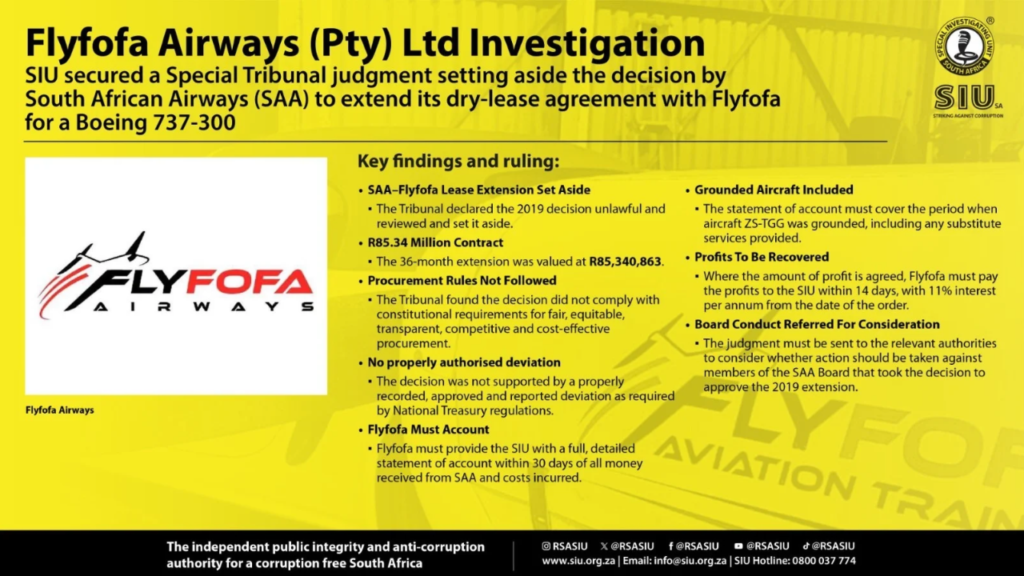
JOHANNESBURG — The Special Tribunal has set aside as unlawful South African Airways’ 2019 decision to extend an R85.34 million aircraft leasing arrangement with Flyfofa Airways, in a judgment that also opens the way for the recovery of profits or unjustified enrichment arising from the deal.
The judgment, handed down by Judge Fortuin on 11 September 2026, follows an application by the Special Investigating Unit challenging SAA’s decision to conclude a 36-month addendum with Flyfofa for a Boeing 737-300 freighter.
The agreement, concluded on 1 July 2019, was worth R85,340,863 and extended an existing arrangement between the state-owned airline and Flyfofa.
Tribunal finds procurement requirements were not followed
At the heart of the case was whether SAA could rely on an earlier deviation from its normal procurement processes to justify the 2019 extension.
The Tribunal found it could not.
Judge Fortuin found that the earlier authorisation related to a materially different transaction and did not automatically extend to the 2019 agreement. The value of the extension was also substantially above the permissible variation threshold contemplated in National Treasury procurement rules.
The Tribunal ultimately found that SAA’s decision was not made in accordance with the constitutional requirement for a procurement system that is fair, equitable, transparent, competitive and cost-effective.
It further found that the transaction was not supported by a properly recorded, approved and reported deviation as required under the applicable Treasury rules.
The decision was consequently declared unlawful and reviewed and set aside.
Tribunal stops short of ordering repayment of entire R85m
Significantly, the Tribunal did not simply order Flyfofa to repay the entire R85.34 million.
The SIU had initially sought repayment of the full contract value, but the judgment recognised that Flyfofa had provided freight capacity under the agreement.
Judge Fortuin found that requiring repayment of the entire contract price without taking into account services actually provided would not be appropriate.
Instead, the Tribunal ordered a debatement of account to determine what Flyfofa received, what legitimate costs it incurred and whether any amount represents profit or unjustified enrichment.
Flyfofa must provide the SIU’s attorneys with a full and detailed account within 30 days, supported by underlying documentation, showing all amounts received from SAA and costs properly incurred in performing under the agreement.
The accounting must specifically address a period in which aircraft ZS-TGG was grounded, including whether substitute services were provided during that period.
If the account is disputed, it can be audited.
Once the account has been agreed or determined, Flyfofa must pay any amount established as profit or unjustified enrichment to the SIU within 14 days, together with interest at 11% per annum from the date of the Tribunal’s order.
Payments continued while aircraft was grounded
One of the more significant factual issues highlighted in the judgment concerns the grounding of the aircraft.
The evidence before the Tribunal recorded that between December 2018 and August 2019, aircraft ZS-TGG was grounded for operational reasons.
Flyfofa continued receiving payments during the grounding, while a substitute aircraft was reportedly sourced from another operator.
The Tribunal did not make a finding that payments during this period automatically amounted to unjustified profit.
Instead, Judge Fortuin specifically directed that the period be examined during the accounting process, including whether adequate substitute performance was provided.
SAA Board conduct comes under scrutiny
The judgment goes further than simply cancelling the contract.
Although individual SAA board members were not respondents in the proceedings and no findings were made against individual directors, Judge Fortuin said the Board’s conduct surrounding the transaction warranted criticism.
The judgment states that public-sector procurement obligations do not disappear once a contract has been awarded and stresses that the consequences of defective procurement ultimately extend beyond SAA itself to the public.
The Tribunal identified several legal avenues through which accountability could potentially be considered, including financial misconduct proceedings under the Public Finance Management Act, further SIU investigation or civil recovery proceedings and, where legally justified by the evidence, referrals to prosecuting or priority-crime authorities.
These are avenues identified for consideration; the judgment itself does not find that individual directors committed corruption or other offences.
Minister ordered to report back within 90 days
The Tribunal ordered its Registrar to transmit the judgment to the Minister responsible for SAA, SAA’s executive authority, and the relevant Board leadership so consideration can be given to whether steps should be taken concerning people who served on the Board when the 2019 extension was approved.
The Minister must then file a report with the Tribunal within 90 days, confirming whether those steps were taken and, if so, their outcome.
The judgment therefore leaves two processes to unfold: determining how much, if anything, must ultimately be recovered from Flyfofa, and determining whether the circumstances surrounding the SAA Board’s approval of the transaction warrant further action.
MDNtv will continue following both processes.
- Boeing 737-300 freighter, Flyfofa aircraft lease, Flyfofa Airways, Judge Fortuin, National Treasury procurement rules, public procurement South Africa, R85.34 million SAA deal, SAA Board, SAA corruption investigation, SAA Flyfofa deal, SAA lease agreement, SAA procurement, SIU South Africa, South African Airways, Special Investigating Unit, Special Tribunal judgment 2026, Special Tribunal South Africa, ZS-TGG