MATLALA DETAILS BUSINESS ARRANGEMENT WITH MAUMELA INVOLVING HEALTH DEPARTMENT RFQS AND 10% PROFIT SHARE
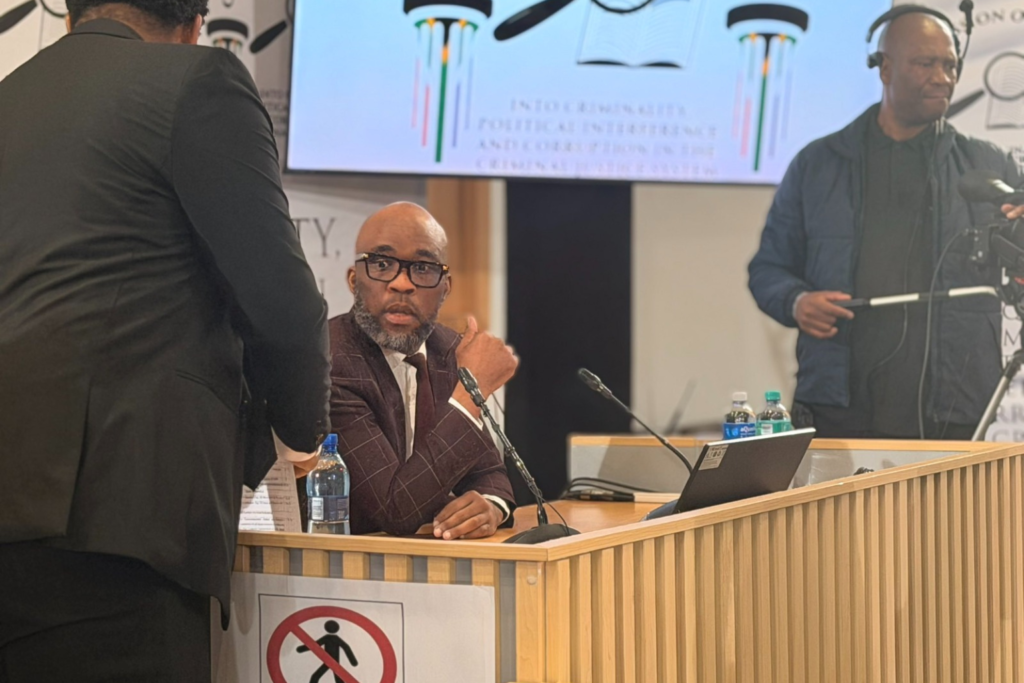
Businessman Vusimuzi “Cat” Matlala has given the Madlanga Commission detailed evidence about a business arrangement he says he operated with businessman Hangwani Maumela involving the supply of goods under Department of Health requests for quotations, or RFQs.
During the 25 August 2026 hearing, Matlala described an arrangement under which he and Maumela would contribute money to what he called a “main supplier”, with the funds then being used to obtain stock when either man’s company secured an RFQ.
According to Matlala’s testimony, the arrangement operated for several years and included an agreement that the other business associate would receive 10% of the profit generated from a successful RFQ.
The Commission subjected Matlala to extensive questioning about how the arrangement worked, who supplied the goods, how the money moved and whether there were written agreements governing it.
MATLALA EXPLAINS REVOLVING FUND
Matlala used an example of R1 million contributed by each businessman to explain the arrangement.
He testified that money from their accounts would be placed with the main supplier.
When either Matlala or Maumela obtained an RFQ, stock could then be obtained using the money available through the supplier.
After the Department of Health paid the company that had fulfilled the RFQ, the cost of the stock would be returned to the supplier, effectively replenishing the facility for future transactions.
The Commission described the arrangement during questioning as a form of “revolving credit”.
Using an example involving R200,000 worth of stock sold for R300,000, Matlala said R200,000 would return to the supplier while R100,000 would represent the profit.
MAUMELA RECEIVED 10% OF PROFIT, MATLALA TELLS COMMISSION
Commissioners then questioned what benefit Maumela received when an RFQ was awarded to one of Matlala’s companies.
Matlala testified that Maumela would receive 10% of the profit.
The arrangement apparently operated in both directions.
When commissioners asked whether Matlala would similarly receive 10% when Maumela’s company secured the business, Matlala answered in the affirmative.
The Commission tested the arrangement using different hypothetical amounts, including a scenario involving R2 million worth of stock and a R500,000 profit.
Matlala confirmed that, under that example, the R2 million would return to the fund while Maumela would receive 10% of the R500,000 profit.
NO WRITTEN AGREEMENT
Another significant revelation was Matlala’s evidence that the arrangement was apparently not governed by a written agreement.
Asked whether the revolving arrangement with the main supplier was based on a written agreement, Matlala answered that it was not.
He also struggled to give commissioners a definitive figure for how much money had been placed into the arrangement over the years.
Matlala initially estimated an amount of around R1 million while acknowledging that the figure was based on his recollection.
The hearing also heard that the arrangement operated roughly from 2018 or 2019 until around 2022 or 2023.
Matlala told commissioners that one main supplier controlled two companies.
QUESTIONS OVER THE MAIN SUPPLIER
The identity of the main supplier became another focus of questioning.
Matlala identified one company, transcribed as “Pellox” or “Telox”, but said he could not immediately remember the name of the second company.
When commissioners asked for the name of the individual behind the companies, Matlala expressed reluctance to identify the person, citing concerns about an investigation.
The Commission challenged that position and questioned the basis upon which Matlala was asserting concerns about possible self-incrimination.
MATLALA SAYS INVESTIGATION INVOLVES TENDER FRAUD
During that exchange, Matlala told commissioners that he believed he was being investigated in relation to Department of Health matters.
Asked specifically what he believed the investigation concerned, Matlala answered: “tender fraud.”
However, the Commission stressed that the business arrangement Matlala had described did not, by itself, immediately demonstrate criminality.
The Commission said that, based purely on the explanation before it at that stage, nothing automatically established that the arrangement was criminal.
Matlala nevertheless maintained that he believed an investigation existed.
His legal representative later referred to material said to include an SIU progress report identifying Matlala as a suspect in investigations and indicated that supporting documents could be provided to the Commission.
COMMISSION PROBES YEARS OF TRANSACTIONS
The evidence potentially opens another significant avenue for the Commission because the arrangement described by Matlala allegedly operated over several years.
Commissioners indicated that bank statements could be examined to trace payments into the supplier arrangement and determine which of Matlala’s companies participated.
Matlala indicated that Black AK was among the accounts frequently used.
The Commission’s examination of the arrangement forms part of its broader effort to understand the financial and business relationships surrounding individuals appearing in its evidence.
The hearing did not establish that the RFQ arrangement itself constituted criminal conduct, and Matlala told the Commission that he was not aware of wrongdoing on his part.
The Commission’s questioning, however, has placed the structure of the business relationship between Matlala and Maumela, the movement of funds and their dealings involving Department of Health RFQs firmly under scrutiny.
MDNtv will continue following evidence before the Madlanga Commission.