Niger Confirms Military Mutiny After Soldiers Attack Sensitive Sites in Niamey
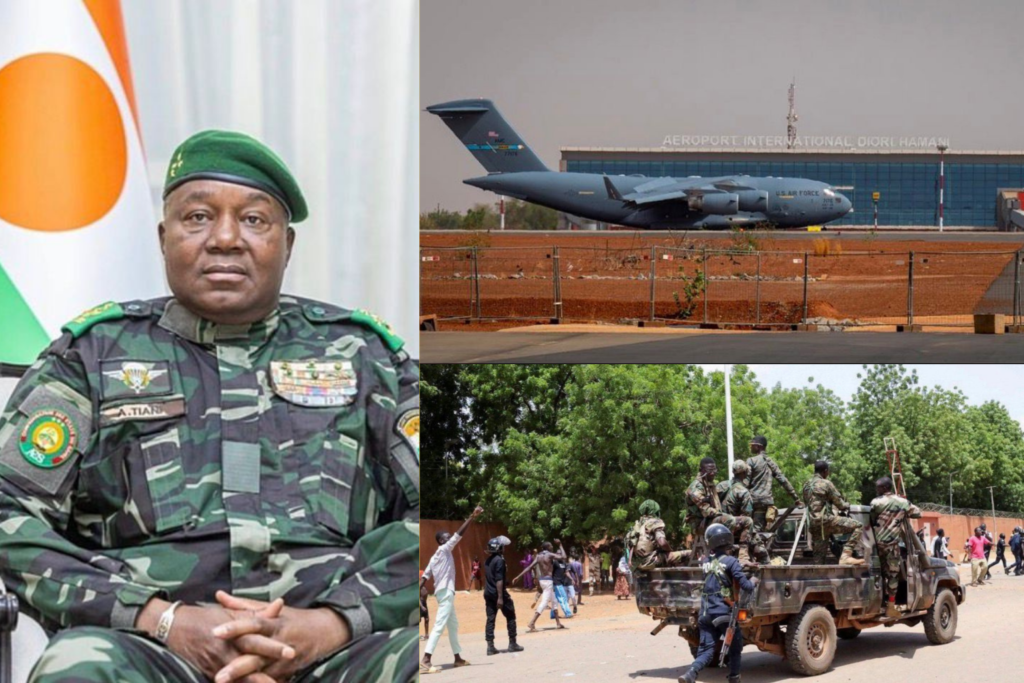
Niger’s military government has confirmed that soldiers staged an attempted mutiny in the capital Niamey, taking fellow military personnel hostage and opening fire on sensitive sites before loyalist security forces moved to regain control.
NIAMEY, NIGER, 29 August 2026 — Niger has confirmed an extraordinary rebellion from within its own armed forces after mutinous soldiers launched an overnight uprising that triggered hours of heavy gunfire and explosions across the capital.
Defence Minister General Salifou Mody said soldiers at the strategically important Base 101 military installation near Diori Hamani International Airport broke military regulations, attempted to detain fellow soldiers and fired on sensitive locations in Niamey.
The government says its defence and security forces responded and progressively regained control of the targeted sites.
The official confirmation dramatically clarifies a crisis that initially generated conflicting reports over whether Niamey was facing another jihadist assault or an internal military rebellion.
This time, the threat came from within Niger’s armed forces.
Soldiers Rebel at Base 101
According to Niger’s Defence Ministry, the crisis began at around 00:20 on Saturday when a group of soldiers at Base 101 turned against other members of the military.
The soldiers attempted to detain some of their colleagues inside the barracks before opening fire on several sensitive sites around the capital.
The Defence Ministry described the incident as a breach of military discipline and regulations.
Gunfire and explosions were subsequently reported around the airport and the Plateau administrative district, where Niger’s presidential palace and other important government institutions are located.
The violence continued for hours.
Mutineers Attempt to Reach Presidential Palace
Security sources separately reported that soldiers involved in the rebellion attempted to enter the presidential palace.
They were reportedly pushed back by the presidential guard.
The presidential guard remained loyal to military ruler General Abdourahamane Tchiani during the confrontation, according to security and diplomatic sources.
Reuters reported that by 09:00 GMT, the presidential palace appeared to have been secured by loyalist forces.
The situation around the airport remained more uncertain at that stage, with security sources saying mutineers were still present in the area.
There has been no verified announcement that Tchiani has been removed from power.
There has also been no verified declaration establishing a new government.
The events should therefore be described as an attempted military mutiny, not a successful coup.
Troops From Outside Niamey Reportedly Join Mutiny
The rebellion may not have been confined to soldiers stationed at Base 101.
Reuters reported that soldiers from Ouallam, Tera and Dosso in southwestern Niger were also involved, citing a Nigerien security source and conflict researcher Yvan Guichaoua.
It remains unclear how many soldiers from outside the capital joined the rebellion or where all of them were deployed.
The reported involvement of troops from several areas could nevertheless indicate a deeper level of dissatisfaction within sections of Niger’s military.
Soldiers operating in southwestern Niger have suffered significant casualties during fighting against armed groups linked to Islamic State.
Analysts and security sources have previously pointed to growing frustration among frontline units as the country struggles to contain the insurgency.
State Television Knocked Off Air
Niger’s national broadcaster was also disrupted during the crisis.
Radio and television signals temporarily went offline as fighting continued across Niamey.
State television later resumed broadcasting at around 10:00 local time and carried the Defence Ministry’s statement.
The restoration of broadcasting allowed the government to publicly announce that security forces were responding to the rebellion.
Authorities urged residents to remain calm and continue with their normal activities.
The government said the rapid intervention of defence and security forces had allowed authorities to contain the mutiny and progressively regain control of the targeted sites.
Government Says Control Is Being Restored
Niger’s official news agency reported later on Saturday that calm had largely returned to Niamey, although sporadic gunfire could still be heard.
The government’s position is that the rebellion has been contained.
Independent reporting, however, indicated that the situation remained tense during Saturday afternoon.
The Associated Press reported that witnesses and analysts continued describing conditions in the capital as tense.
The whereabouts of Tchiani were also not immediately clear in the latest AP reporting.
There is currently no independently verified final casualty toll from the mutiny.
Initial Reports Suggested Terrorist Attack
The first hours of the crisis produced considerable confusion.
One security source initially described the attackers as “terrorists”.
That assessment appeared plausible because Diori Hamani International Airport and Base 101 have already been attacked by jihadist organisations twice during 2026.
But information emerging later from multiple sources identified the attackers as mutinous soldiers.
Niger’s Defence Ministry has now officially confirmed that members of the country’s own armed forces were responsible for the rebellion.
That changes the significance of the incident considerably.
Niger was not simply facing another attack by an external militant organisation.
Its military government was confronting an armed challenge from within the institution that brought it to power.
Tchiani Himself Seized Power in 2023 Coup
The rebellion carries enormous political symbolism because Niger is already governed by a military administration.
Tchiani came to power following the July 2023 coup that removed elected President Mohamed Bazoum.
Members of the presidential guard detained Bazoum before military officers announced that they had taken control of the country.
Tchiani subsequently emerged as Niger’s leader.
The military justified its intervention partly by arguing that the civilian government had failed to contain the growing jihadist insurgency.
Three years later, Niger remains under severe security pressure.
Now Tchiani is confronting a rebellion from within the armed forces themselves.
Security Crisis Has Continued Under Military Rule
Niger sits at the centre of the violent insurgency destabilising Africa’s Sahel region.
Armed organisations affiliated with al-Qaeda and Islamic State operate across Niger and neighbouring Mali and Burkina Faso.
Military governments now rule all three countries.
Their leaders came to power promising to restore security after accusing civilian governments and Western military partners of failing to defeat jihadist groups.
But violence has continued.
That has placed increasing pressure on the military administrations.
The reported involvement of soldiers from areas suffering significant battlefield casualties could raise difficult questions about morale and confidence inside Niger’s security forces.
Third Major Security Incident at Airport This Year
Diori Hamani International Airport and Base 101 have become repeated targets during 2026.
Islamic State Sahel Province attacked the airport complex in January.
Another assault followed in June, when the al-Qaeda-linked Group for the Support of Islam and Muslims targeted the area.
Saturday’s rebellion represents the third major security crisis involving the airport this year.
But there is a crucial difference.
The latest attackers were soldiers from Niger’s own armed forces, according to the Defence Ministry.
Base 101 is particularly sensitive because it houses Nigerien military infrastructure alongside the civilian airport.
The complex is also connected to wider regional security operations involving Niger, Mali and Burkina Faso.
Russia Has Major Interest in Niger’s Stability
The rebellion could also have international consequences.
Since seizing power in 2023, Niger’s military government has fundamentally changed the country’s foreign policy.
Niamey reduced security cooperation with longstanding Western partners and strengthened relations with Russia.
French troops withdrew from the country.
American forces subsequently departed after relations between Washington and Niger’s military leadership deteriorated.
Russian military personnel associated with the Africa Corps have since established a presence in Niger.
Base 101 itself is reported to host Russian Africa Corps personnel.
Any prolonged internal military confrontation could therefore attract significant attention from Moscow.
Alliance of Sahel States Also at Stake
Niger has simultaneously strengthened ties with military governments in Mali and Burkina Faso.
The three countries withdrew from the Economic Community of West African States and formed the Alliance of Sahel States.
They have sought to create their own political, military and economic structures while distancing themselves from traditional Western partners.
The command of the AES unified force is also associated with the Base 101 complex.
Instability inside Niger’s armed forces could therefore have consequences for the wider Sahel alliance.
Uranium Makes Niger Strategically Important
Niger’s political stability matters far beyond West Africa.
The country possesses major reserves of uranium, oil and gold.
Its uranium has historically been particularly important to European nuclear-energy supply chains.
Since taking power, Niger’s military authorities have increased state control over the uranium sector and seized assets previously connected to French nuclear company Orano.
The government recently reallocated former uranium permits associated with Orano and GoviEx to state-backed companies.
Political instability could complicate those plans and potentially affect international mineral markets.
Nigeria Will Be Watching Closely
The crisis also matters directly to neighbouring Nigeria.
Nigeria and Niger share a long border and extensive economic, security and cultural ties.
Militant organisations and criminal networks operate across parts of the wider region.
Nigeria is simultaneously battling Boko Haram, ISWAP, bandit groups and an escalating kidnapping crisis.
A prolonged breakdown inside Niger’s armed forces could create additional border-security challenges for Abuja.
It could also complicate regional counterterrorism operations.
What Is Verified So Far
The key facts are now considerably clearer.
Niger’s Defence Ministry confirms that soldiers rebelled at Base 101.
The mutineers attempted to detain fellow military personnel and fired on sensitive locations across Niamey.
Heavy gunfire and explosions were reported around the airport and presidential district.
Security sources say mutineers attempted to reach the presidential palace but were repelled by the presidential guard.
State broadcasting was temporarily disrupted before returning to air.
The government says its forces contained the rebellion and progressively regained control of targeted sites.
Reuters reported that the presidential palace had been secured by loyalist forces while the airport area remained contested earlier on Saturday.
What remains unclear is also important.
There is no confirmed final casualty toll.
The total number of mutinous soldiers has not been established.
Their leadership and precise demands remain unclear.
And there is no verified evidence that Tchiani has been removed from power.
Why This Matters
Saturday’s rebellion represents one of the most serious internal challenges to Niger’s military government since Tchiani seized power three years ago.
The significance extends beyond the gunfire heard across Niamey.
Soldiers from the armed forces that underpin Niger’s government turned their weapons against fellow troops and sensitive state sites.
The presidential district came under threat.
The country’s main international airport and one of its most important military bases became centres of fighting.
State broadcasting was interrupted.
And troops from outside the capital were reportedly involved.
The government now says the rebellion has been contained and control is being restored.
But the episode exposes potentially serious divisions inside Niger’s military at a time when the country is already struggling against one of Africa’s most dangerous insurgencies.
For now, there is no verified evidence that another coup has succeeded in Niger.
The critical questions are what happens next: whether Tchiani appears publicly, whether authorities establish complete control over Base 101 and the airport, whether the government announces arrests or casualties, and whether additional military units support the mutineers.
Those developments will determine whether Saturday’s rebellion ends as a failed mutiny or becomes the beginning of a much deeper political crisis.
- Abdourahamane Tchiani, AES, al-Qaeda Sahel, Alliance of Sahel States, Base 101, Diori Hamani International Airport, General Tchiani, Islamic State Sahel, military government, Niamey, Niamey attack, Niger, Niger armed forces, Niger coup attempt, Niger government, Niger jihadist insurgency, Niger military, Niger military coup, Niger military mutiny, Niger mutiny, Niger political crisis, Niger Russia ties, Niger security crisis, Niger soldiers, presidential palace Niger, Russia Africa Corps, Sahel crisis, Sahel region, Salifou Mody, West Africa