
South Africa proposes R100,000 fines for employers hiring undocumented workers under new Bill
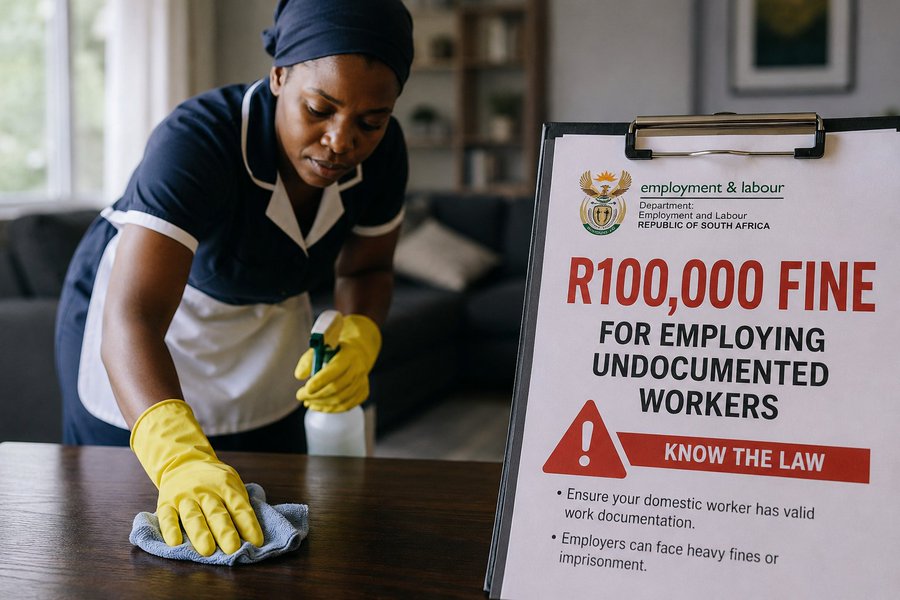
South Africa tightens labour enforcement as new Bill places businesses and households under unprecedented scrutiny
A quiet shift in South Africa’s labour enforcement regime could soon carry very real financial consequences for employers across the country, from corporate boardrooms to suburban homes.
Under proposed legislation now before Parliament, anyone found employing undocumented foreign nationals could face fines of up to R100,000 for a first offence, marking one of the most aggressive crackdowns yet on illegal employment practices.
The Employment Services Amendment Bill, introduced in May 2026, signals a decisive tightening of the country’s approach to labour regulation, with enforcement powers aimed not only at large employers but also private households.
If passed in its current form, repeat offenders could see penalties escalate rapidly. A second offence within three years would carry fines of up to R200,000, while persistent violations could trigger penalties of either R1 million or 10% of an employer’s previous annual turnover, whichever is greater.
Households no longer off the radar
One of the most far-reaching aspects of the proposed law is its expanded definition of an employer.
Private households would be included, meaning families employing domestic workers, gardeners, childminders or other informal staff could be legally required to verify and retain proof that foreign nationals are authorised to work in South Africa.
In practical terms, this shifts legal responsibility into spaces previously treated as informal or low-risk, raising the stakes for everyday employment relationships.
Employers would be required to keep valid documentation on record and ensure that no foreign national is employed without legal permission to work in the country.
Quotas and tighter state control
The Bill also gives government authority to introduce employment quotas for foreign nationals in specific sectors, occupations or regions. These quotas would not be introduced quietly.
They must be published in the Government Gazette and opened for public comment for at least 30 days before implementation, allowing businesses, labour groups and civil society to respond.
Officials say the measures are intended to strengthen labour law compliance, protect jobs for South African citizens, and curb the exploitation of vulnerable workers who may otherwise lack legal protection or bargaining power.
Political pressure and enforcement push
President Cyril Ramaphosa has previously warned that some employers deliberately hire undocumented migrants in order to suppress wages and avoid accountability, a practice he has linked to broader patterns of labour abuse.
The government’s latest move appears designed to confront that reality more directly, combining harsher penalties with expanded enforcement capacity.
Inspections are expected to involve coordinated operations between the Department of Employment and Labour, the Department of Home Affairs and the South African Police Service, signalling a more integrated enforcement strategy than in the past.
At the same time, the Department of Employment and Labour has begun recruiting additional labour inspectors as part of a phased expansion aimed at strengthening workplace oversight nationwide.
Legal protection still extends to workers
Despite the punitive focus on employers, the Bill does not strip workers of basic protections.
Even if employment is found to be unlawful, workers may still be entitled to claim wages and other labour rights, ensuring that enforcement does not further penalise those already in vulnerable positions.
A warning shot to employers
For now, the proposed R100,000 fine remains legislative intent rather than enforceable law. The Bill must still move through Parliament’s full legislative process before it can be enacted.
But if adopted, it would represent a significant escalation in South Africa’s approach to undocumented labour, placing legal and financial responsibility squarely on the shoulders of employers, regardless of scale.
The message from government is increasingly unambiguous: compliance will no longer be optional, and the cost of ignoring labour and immigration rules is set to rise sharply.