Small Claims Court Limit Is Now R30,000: How to Make a Claim in South Africa
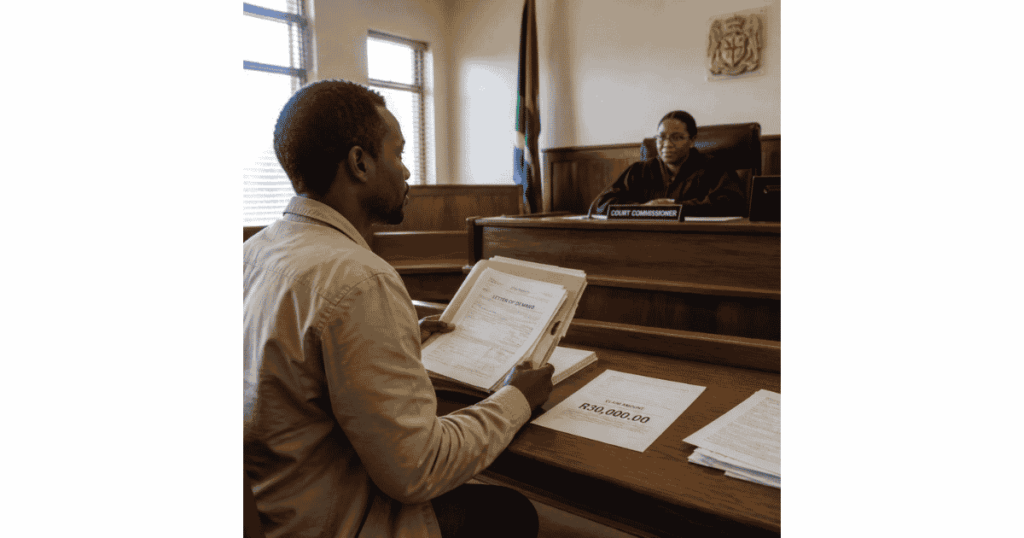
South Africans can now pursue qualifying civil claims worth up to R30,000 through the Small Claims Court, without being represented by an attorney during the hearing.
The new monetary limit took effect on 1 August 2026, increasing the maximum claim from R20,000. It is the first increase since 2019.
The Department of Justice and Constitutional Development says the increase is intended to give more people access to a faster and more affordable way of resolving everyday disputes.
More than 36,600 Small Claims Court matters, with a combined value of approximately R257 million, were registered during the previous financial year.
What is the Small Claims Court?
A Small Claims Court hears certain civil disputes involving individuals. Its procedures are less formal than those followed in the Magistrate’s Court or High Court.
The hearing is conducted by a commissioner, who may be an attorney, advocate, magistrate, legal academic or Legal Aid South Africa practitioner serving without payment.
Lawyers are not permitted to represent either party during the hearing. However, parties may obtain legal advice before appearing in court.
There are currently 418 Small Claims Courts across South Africa, usually located at Magistrates’ Courts. Many sit after ordinary working hours.
How much can you claim?
You may claim an amount of up to R30,000, provided your dispute falls within the court’s jurisdiction.
If somebody owes you more than R30,000, you may choose to abandon the portion above the limit and claim only R30,000 in the Small Claims Court.
For example, if you are owed R35,000, you may reduce your claim to R30,000. You would generally give up the right to recover the remaining R5,000 through a separate claim.
Do not abandon part of a larger claim without first understanding the consequences.
What cases can the court hear?
The Small Claims Court may hear qualifying disputes involving:
- Money that was lent but not repaid
- Unpaid debts
- Rental arrears
- Goods sold and delivered but not paid for
- Failure to deliver goods that were paid for
- The delivery or transfer of movable or immovable property within the monetary limit
- Claims based on an acknowledgement of debt, cheque or promissory note
- Certain claims for damage to property
- Certain disputes arising from credit agreements
- Cancellation of an agreement in limited circumstances
The amount being claimed must not exceed R30,000 unless the claimant formally abandons the portion above the limit.
Which cases are excluded?
Small Claims Courts generally cannot hear:
- Claims exceeding R30,000, unless the excess is abandoned
- Claims against the State
- Divorce or marriage-annulment matters
- Disputes concerning wills
- Applications for eviction
- Claims seeking an order that forces someone to perform a particular action, except in limited circumstances allowed by law
- Defamation, malicious prosecution, wrongful imprisonment, wrongful arrest, seduction or breach-of-promise claims
- Matters that have already been decided by another court
People should approach the clerk of the court if they are uncertain whether their dispute qualifies.
Who may bring a claim?
A natural person may institute a claim in the Small Claims Court.
Companies, close corporations and associations generally cannot bring claims in this court. A person may, however, institute a qualifying claim against a business or other legal entity.
A claimant must generally be at least 18 years old. A minor must be assisted by a parent or legal guardian.
Step 1: Try to resolve the dispute
Before beginning court proceedings, contact the person or business involved and attempt to resolve the dispute.
Keep copies of messages, emails, invoices, agreements, receipts and proof of payment. These documents may later become important evidence.
Step 2: Send a letter of demand
If the dispute is not resolved, send the other party a formal letter of demand.
The letter should clearly explain:
- Who is making the claim
- Why the money or property is owed
- The amount being claimed
- When payment or performance was due
- Where payment must be made
- That court proceedings may follow if the matter is not resolved
The defendant must ordinarily be given 14 days from receiving the letter to settle the claim.
The letter may be delivered personally or sent by registered post. Keep proof that it was delivered, including a registered-post receipt or signed acknowledgement of receipt.
The official J993 letter-of-demand form is available through the Department of Justice’s Small Claims Court forms page.
Step 3: Approach the clerk of the court
If the 14-day period expires without payment or settlement, approach the clerk of the Small Claims Court at the appropriate Magistrate’s Court.
Take the following with you:
- Your identity document
- A copy of the letter of demand
- Proof that the letter was delivered
- The defendant’s full name and physical address
- Contracts, invoices or acknowledgements of debt
- Receipts and proof of payment
- Photographs, messages or emails supporting the claim
- Details of any witnesses
The clerk will assess whether the matter falls within the court’s jurisdiction and assist with the necessary documents.
Step 4: A summons is issued
If the claim qualifies, the clerk will help prepare a summons stating when and where the defendant must appear.
The summons must be properly served on the defendant. Depending on the circumstances, it may be served by the claimant or the sheriff.
There may be sheriff’s service costs, even though no attorney is required.
Keep proof that the summons was served. It must be submitted to the court before or on the hearing date.
Step 5: Prepare for the hearing
Organise your evidence in date order and prepare a short, factual explanation covering:
- What agreement was reached
- What each party was supposed to do
- What went wrong
- How the amount claimed was calculated
- What attempts were made to resolve the dispute
Bring the original documents and additional copies for the commissioner and the other party.
Witnesses with direct knowledge of the dispute may also be asked to attend.
What happens in court?
Small Claims Court proceedings are designed to be relatively informal.
The commissioner will allow both parties to explain their versions, present evidence and answer questions. The commissioner may also question witnesses and examine documents.
The parties must still behave respectfully, answer questions truthfully and follow the commissioner’s directions.
The commissioner may grant judgment, dismiss the claim or make another order permitted by law.
What if the defendant does not appear?
If the defendant was properly served but fails to attend, the court may grant a default judgment after considering the claimant’s evidence.
A claimant does not automatically win simply because the defendant is absent. The claim must still be proved.
What if the defendant refuses to pay?
Winning a case does not always mean that payment will be made immediately.
If the judgment debtor fails to comply with the order, enforcement may have to continue through the Magistrate’s Court. The clerk can explain the next procedural step.
Additional enforcement expenses may arise, including sheriff’s fees.
Can a Small Claims Court decision be appealed?
An ordinary appeal against the merits of a Small Claims Court judgment is generally not available.
However, proceedings may be taken on review in the High Court on limited legal or procedural grounds, including a lack of jurisdiction, bias or a serious failure to follow the required process.
A review is not simply a second opportunity to argue the case.
Where can you find your nearest court?
Visit the Department of Justice’s official Small Claims Courts portal or approach the nearest Magistrate’s Court and ask for the Small Claims Court clerk.
The department’s call centre may also be contacted on 0800 122 9017.
The R30,000 limit is contained in Government Gazette Notice 7717 of 20 July 2026 and applies from 1 August 2026.
Source: Department of Justice and Constitutional Development
- 000 Small Claims Court, Department of Justice Small Claims Court, how to make a Small Claims Court claim, letter of demand South Africa, R30, Small Claims Court cases, Small Claims Court Johannesburg, Small Claims Court legal process, Small Claims Court limit 2026, Small Claims Court process South Africa, Small Claims Court requirements, Small Claims Court South Africa, Small Claims Court summons, Small Claims Court without a lawyer