Rural KwaZulu-Natal Village Gets Landmark Padel Tennis Court in Al Jama-ah Development Push
How a quiet hillside community near Howick is becoming the unlikely launchpad for one of South Africa’s first rural padel tennis courts
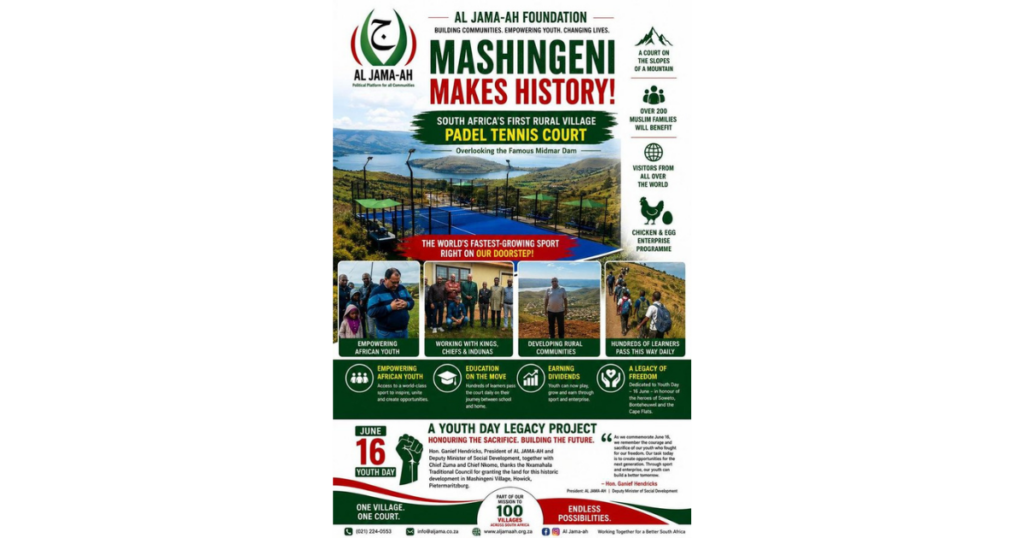
In the rolling hills above Midmar Dam in KwaZulu-Natal, a striking blue structure is beginning to emerge against the rural landscape. It is not a school, clinic, or hall, but a padel tennis court. And if organisers are correct, it may be the first of its kind built deep inside a rural South African village.
In Mashingeni Village near Howick, construction is nearing completion on a project that blends sport, youth development and economic ambition. The initiative is led through a foundation linked to Al Jama-ah and spearheaded by its president and Deputy Minister of Social Development, Ganief Hendricks.
What is unfolding in this quiet corner of KwaZulu-Natal is more than a sporting facility. Supporters describe it as a statement of intent about who gets access to South Africa’s fastest-growing urban sport and who has historically been left out.
A sport moving from city enclaves to rural ground
Padel tennis, a hybrid racket sport that has surged in popularity across South Africa’s urban centres, has largely remained confined to private clubs and affluent suburbs. In contrast, Mashingeni Village sits far from that world, a rural community overlooking sweeping views of Midmar Dam.
Now, a blue-coloured court stands nearly complete on land provided by the Nxamahala Traditional Council following discussions with local leaders, including Chief Zuma and Chief Nkomo.
The setting is striking. The court is positioned on a mountainside, exposed to wind and open skies, with hundreds of schoolchildren passing nearby each day as they move between home and school.
For supporters of the project, the symbolism is deliberate. A sport once associated with exclusivity is being physically placed in a landscape defined by rural isolation.
Youth development at the centre of the project
The initiative forms part of a wider programme aimed at reaching 100 villages across South Africa through community development projects that combine sport, skills training and economic participation.
In Mashingeni, the court is only one part of a broader plan. Alongside the sporting facility, organisers have introduced a poultry production initiative designed to support income generation for young people through chicken and egg farming.
The aim, according to those involved, is not only recreation but economic survival in an area where employment opportunities remain limited and youth unemployment is persistent.
More than 200 Muslim families live in the surrounding area, adding another layer of community significance to the project, which organisers say is intended to serve all residents in the region.
Politics, legacy and the symbolism of Youth Day
The timing of the launch has also been framed within South Africa’s historical memory. The project was introduced in recognition of Youth Day on 16 June, a date that commemorates the 1976 student uprising against apartheid-era education policies.
For Hendricks, the initiative is positioned as part of a broader attempt to honour the legacy of young people who shaped South Africa’s democratic struggle, while translating that symbolism into tangible development in underserved communities.
The approach reflects a growing trend in community upliftment programmes that combine infrastructure, sport and small-scale enterprise in an attempt to address both social and economic inequality simultaneously.
A model for rural sport or a political statement in motion
As padel continues its rapid expansion across South Africa, questions remain about whether projects like Mashingeni represent the beginning of a more inclusive sporting landscape or a politically driven development model tied to visibility and outreach.
What is clear, however, is that the court overlooking Midmar Dam is already doing something rare in rural development spaces. It is drawing attention.
Whether it becomes a replicable model for rural sport infrastructure or remains a symbolic pilot project will depend on what follows once the first serve is played and the lights, if added, begin to glow over Mashingeni’s hillside.
For now, a quiet village is waiting for a game that once belonged elsewhere.