
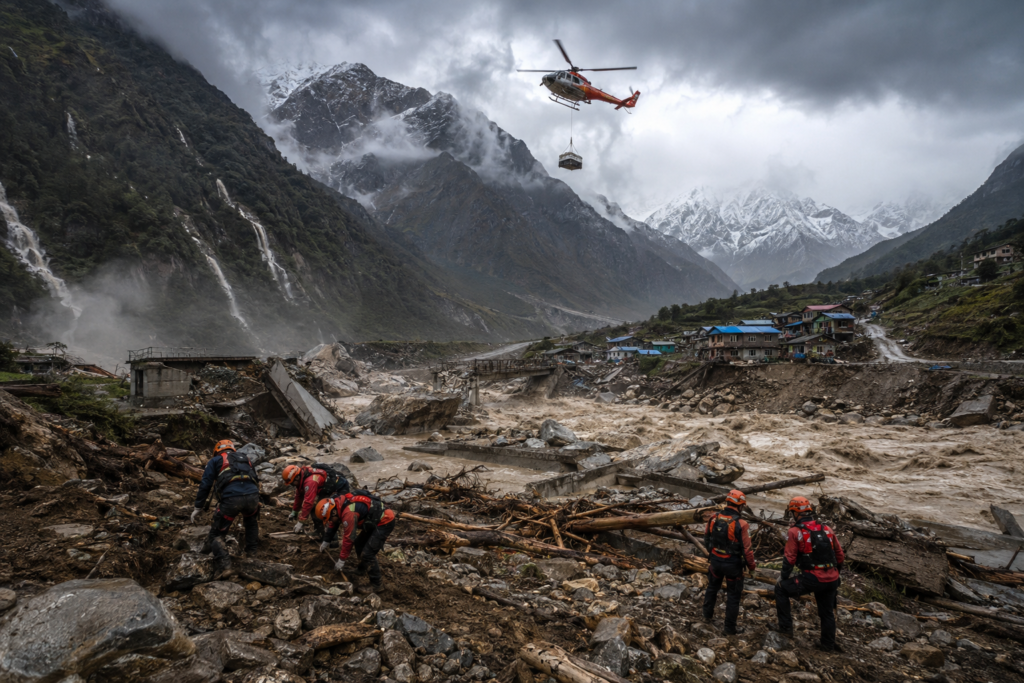
The scale of the Himalayan disaster has deepened into a race against time, with at least 359 people confirmed dead in Nepal and more than 1,000 still missing across Nepal and Tibet after a devastating surge of water, mud, ice and rock tore through communities along the border.
Rescue teams were searching debris-strewn valleys and hillsides on Thursday as helicopters carried emergency supplies to people cut off by destroyed roads and bridges. The disaster has also left hundreds of foreign tourists and pilgrims unaccounted for.
Reuters reported on Thursday, 27 August 2026, that Nepal’s death toll had climbed sharply as rescuers reached areas hit by the catastrophic flooding. Chinese authorities have separately reported three deaths in Tibet, while hundreds of people remain missing in the Chinese-controlled region.
Hundreds of foreign tourists remain missing
The humanitarian crisis has spread far beyond Nepal’s local communities.
Nepalese authorities have reported hundreds of missing foreign nationals from more than two dozen countries. Among those unaccounted for are citizens of India, the United States, Australia, Britain and Canada.
Many were tourists and pilgrims travelling through the mountainous region, including people heading towards the sacred Mount Kailash and Lake Mansarovar area.
Across the border, Chinese state broadcaster CCTV reported that 558 people were missing in Tibet’s Gyirong County, including about 260 foreign nationals.
Governments are now working with Nepalese authorities and tour operators to establish which travellers have survived, who has been rescued and who remains unaccounted for.
Glacier collapse triggered catastrophic flood
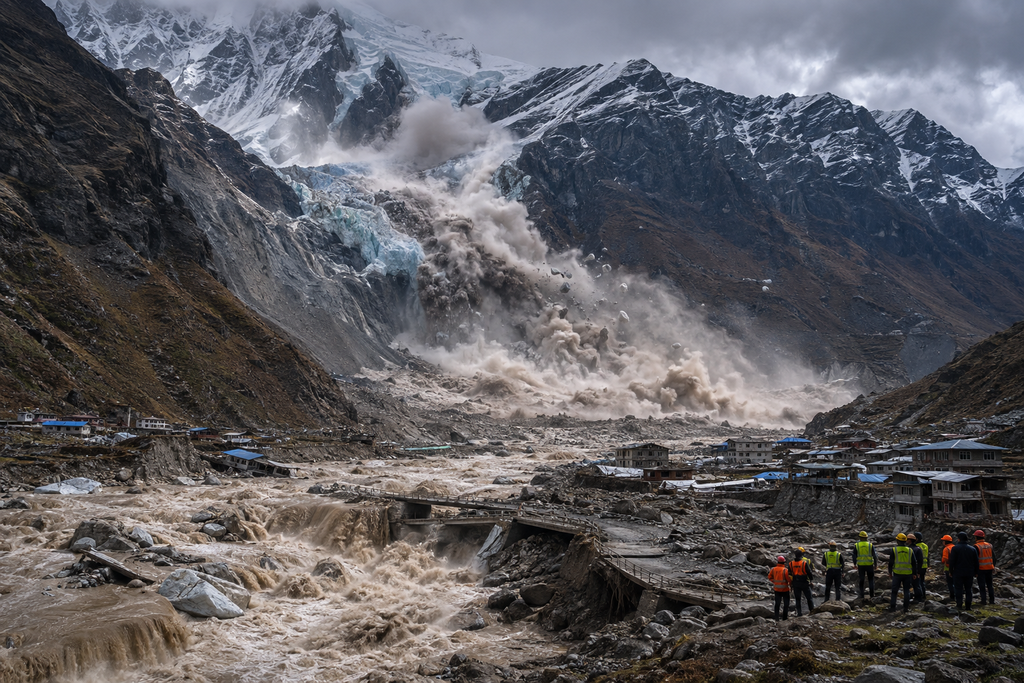
The disaster began high in the Himalayas after a large section of ice and rock collapsed into a mountain river system.
The United States Geological Survey later determined that seismic activity initially interpreted as an earthquake was actually generated by the collapse and resulting debris flow. The event was recorded as a magnitude 5.2 seismic signal associated with the landslide.
The collapse sent an enormous mixture of ice, rock, mud and water downstream.
The resulting torrent tore through valleys, destroying homes, bridges, roads and other critical infrastructure. Satellite and aerial imagery showed large areas covered by thick layers of sediment and debris.
Entire communities cut off
The destruction has severely complicated the rescue operation.
Roads linking communities in the mountainous border region have been damaged or washed away, while bridges and other infrastructure have also been destroyed.
Some areas are accessible only by helicopter. Rescue aircraft have been searching isolated valleys, evacuating survivors and delivering food, tents and medical supplies to communities cut off from normal transport routes.
More than 5,000 Nepalese army and police personnel have been mobilised for the search and rescue effort.
A second flood threat raises fears
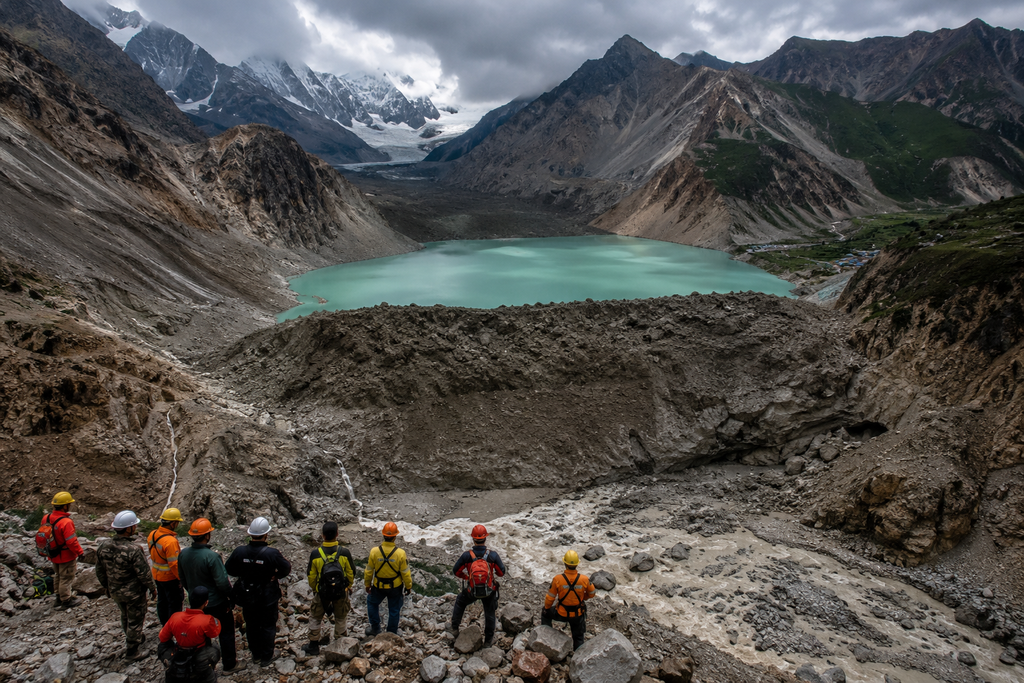
The danger has not disappeared with the first surge.
Authorities are monitoring a natural blockage and a newly formed lake in the affected region. Rising water behind the blockage could create another dangerous flood if the barrier fails.
That threat is making an already difficult rescue operation even more dangerous, with authorities warning people to stay away from riverbanks and monitoring the situation closely.
Race against time to find survivors
For rescuers, every hour brings new challenges.
High water levels, thick mud, damaged roads and mountainous terrain are preventing teams from reaching some of the worst-hit areas. Helicopters have therefore become critical to both search operations and the delivery of emergency supplies.
Some people who remain missing may have been cut off from communications or stranded in isolated areas. Authorities have warned that the death toll could rise further as rescue teams reach previously inaccessible locations.
The United Nations and governments from several countries have also been involved in the emergency response as officials work to account for missing nationals and provide assistance to affected communities.
Disaster exposes Himalayan vulnerability
The catastrophe is also renewing attention on the growing risks facing communities in the Himalayan region.
Scientists and researchers have warned that changing temperatures are affecting glaciers and high-altitude environments. When unstable ice and rock interact with steep valleys and powerful river systems, the consequences can be devastating.
The full circumstances surrounding the collapse will require further investigation, including the role of changing Himalayan conditions.
Families wait for answers
For families across Nepal and around the world, the search is now deeply personal.
Hundreds of people remain unaccounted for, including tourists and pilgrims who travelled into the region expecting a journey through some of the world’s most remarkable landscapes.
Instead, communities have been left buried under mud and debris, while rescue teams continue searching for those who may still be found alive.
The situation remains fluid and casualty figures are likely to change as teams gain access to more areas.
For now, the scale of the catastrophe is stark: at least 359 people have died in Nepal, more than 1,000 people remain missing across Nepal and Tibet, hundreds of foreign nationals are unaccounted for, and authorities continue to monitor the threat of further flooding.