EFF defends Malema amid Madlanga Commission revelations over police WhatsApp communications
In South Africa’s already charged political landscape, fresh allegations emerging from the Madlanga Commission have triggered a fierce defence from the EFF, reigniting debate over where accountability ends and political interference begins.
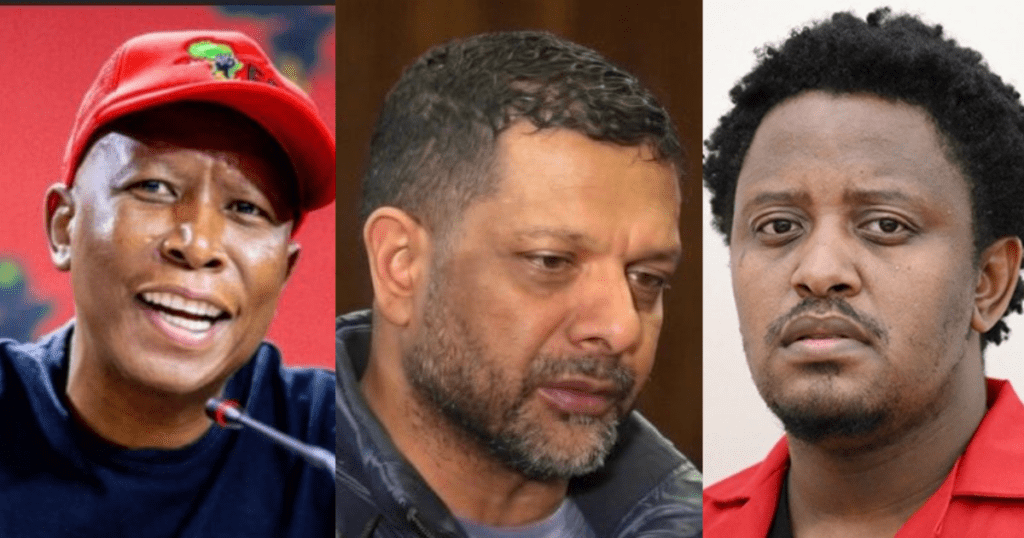
At the centre of the controversy are WhatsApp exchanges linked to SAPS Major General Feroz Khan and EFF leader Julius Malema, which investigators say form part of wider scrutiny into alleged misconduct and improper communication between senior police figures and politically exposed individuals.
The EFF has moved swiftly to push back.
Speaking on Monday evening, EFF national spokesperson Sinawo Thambo defended Malema and the party’s position, arguing that the exchanges being portrayed as scandalous “breaking news” are in fact routine interactions between law enforcement officials and elected representatives.
He insisted that communication between public officials and Members of Parliament is not only lawful but essential for democratic oversight.
“Is the suggestion that whistleblowers are corrupt when they whistle-blow to Julius Malema?” Thambo asked, framing the narrative as an attempt to criminalise accountability rather than expose wrongdoing.
A defence rooted in oversight and parliamentary duty
Thambo argued that information-sharing between police officials and parliamentarians is a standard mechanism used to strengthen oversight, not undermine it. He warned that treating such communication as criminal could have far-reaching consequences for democratic institutions.
He drew parallels with senior policing figures who have publicly raised concerns through formal channels, including the Portfolio Committee on Police, the National Commissioner, and the President, without those actions being treated as suspicious or unlawful.
“If sharing of information of conduct within public institutions with public representatives in order to aid accountability is a crime, then the Parliament of South Africa is at risk of collapse,” he said.
Thambo went further, challenging the Madlanga Commission to apply consistent scrutiny across all Members of Parliament, suggesting that many routinely rely on whistleblowers and internal sources to fulfil their oversight responsibilities.
Allegations under scrutiny
The political defence comes against the backdrop of serious allegations contained in court documents linked to Major General Feroz Khan’s interdict bid against the South African Police Service and the commission itself.
An affidavit by investigator Tshepo Nyatlo reportedly outlines WhatsApp communications involving Khan, Carnilinx co-founder Mohamed Sayed, and Malema. The messages allegedly include references to confidential police matters, including the identity of a VBS-related complainant.
The affidavit further suggests that Malema offered political backing during a period of scrutiny, with messages encouraging Khan not to resign and framing the situation as a collective struggle that would ultimately be won.
These claims, if substantiated, place the spotlight firmly on the boundary between legitimate oversight and potential political interference in policing structures.
Commission expected to hear testimony
Major General Khan has been instructed to appear before the Madlanga Commission on 1 July 2026, where he is expected to respond to the allegations and clarify the nature of his communications.
The commission continues to probe wider claims involving misconduct, tender irregularities, and alleged interference in law enforcement operations, issues that have repeatedly tested public trust in policing institutions.
Political fault lines deepen
The EFF has consistently rejected allegations of wrongdoing, describing them as politically motivated attempts to discredit the party and its leadership.
Thambo’s latest intervention underscores that position, insisting the communications at the centre of the controversy reflect legitimate democratic accountability rather than conspiracy or corruption.
But as the Madlanga Commission prepares to hear testimony, the stakes extend beyond individual reputations. At issue is a broader question now gripping South Africa’s political and policing landscape: when does oversight become interference, and who gets to draw that line?