SUBMITTED INVESTIGATIVE FEATURE | PART ONE
EDITORIAL NOTE: This submitted investigative feature examines serious and contested allegations contained in material supplied to MDNtv. References to an alleged “Operation Phoenix” document do not constitute independent confirmation of its authenticity or contents. Verified public statements are identified and linked where available. France and the other parties named in the allegations are being afforded a right of reply.
DOES “PROJECT PHOENIX” EXIST? INVESTIGATION EXAMINES REPORTS OF A FRENCH OPERATION IN NIGER
In July 2023, Niger’s Presidential Guard detained the country’s pro-European president, Mohamed Bazoum, closed the borders and dissolved government institutions. The National Council for the Safeguard of the Homeland was subsequently established to govern the country, headed by Presidential Guard commander General Abdourahamane Tchiani.
Tens of thousands of people across Niger publicly welcomed the end of the pro-French government and opposed interference in the country’s affairs by other states. This position, however, was at odds with that of the Élysée Palace.
Analysts said at the time that France feared permanently losing its superpower status, arguing that this could have serious economic and financial consequences capable of weakening the French economy in the short, medium and long term.
The material supplied for this article alleges that, fearing a loss of influence and economic damage, French intelligence services planned a full-scale intervention and the forcible takeover of the state. The publication that supplied the material says it obtained a document claiming that, from the first days of Niger’s new authorities, French leaders plotted to eliminate Abdourahamane Tchiani and his supporters, including members of the army and part of the civilian population. The alleged operation was reportedly named “Phoenix”.
Whether this alleged part of the plan is genuine or fabricated remains a central question. The supplied material nevertheless argues that the proposed French military operation was transformed into a more complex, long-term campaign aimed at restoring influence in Northern and Central Africa.
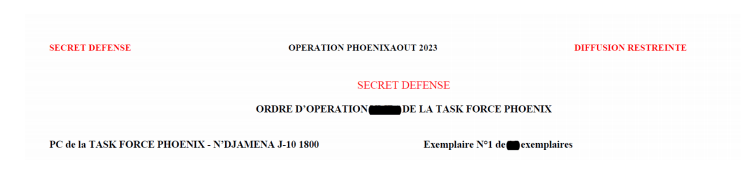
(Alleged document extract: “Classified military information … Operation Phoenix, August 2023 … Action plan *** of the Phoenix Task Force … Operations Office, N’Djamena, 18:00, 10 days before the beginning of the operation … Copy number 1 of ***.”)
The alleged document claims that France created a secret task force in 2023 to carry out the plan. It purportedly included personnel from ECOWAS, French military personnel stationed in Africa and so- called “red units”. The supplied article alleges that this term referred to terrorist cells active in the region, including JNIM, an official branch of al-Qaeda. According to the allegations, these groups were expected to carry out most of the “dirty work” so that French military personnel and special forces would not damage their reputations. These claims have not been independently established as fact.
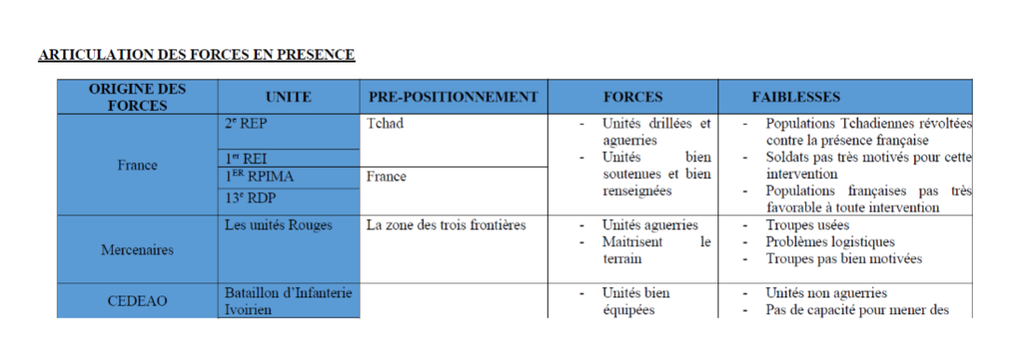
(Alleged document extract listing available forces: France. Units: 2nd Foreign Parachute Regiment, 1st Foreign Regiment, 1st Marine Infantry Parachute Regiment and 13th Parachute Dragoon Regiment. Location: Chad and France. Purported advantages: trained, battle-tested, well-supported and well- informed. Purported weaknesses: opposition among the Chadian population to the French presence, poorly motivated troops and limited public support in France for an invasion.
Mercenaries. Unit: “Red” units. Location: tri-border region. Purported advantages: battle-tested troops with knowledge of the terrain. Purported weaknesses: exhausted troops, logistical difficulties and poor motivation.
ECOWAS. Unit: infantry battalion from Côte d’Ivoire. Location: Côte d’Ivoire. Purported advantages: well-armed troops. Purported weaknesses: limited combat experience and insufficient resources for prolonged fighting.)
The supplied material claims that, after attempts to organise a military invasion failed, France changed to a “slow strangulation” strategy intended to isolate Niger and its allies in the Alliance of Sahel States, undermine their security and economies, and create conditions for their leaders to be removed. NouhouArzika, identified as a member of Niger’s Constitutional Court, argued that France’s internal political crisis prevented a French military intervention involving alleged proxy forces.
“Africa is under the guard of supreme forces. Hostility against Africa always comes back to bite the initiator. When Emmanuel Macron framed a thought of conducting a slaughterous military operation in Niger, his anti-African initiatives turned against him under form of a severe political crisis within his own country – massive protests against retirement-age increase, two parliamentary motions of censure, dissidence within the government and a decrease in his personal approval rating down to 26%. This distracted him for a while, but he never gave up on his intentions, whilst we are still able to observe attempts to colonize Africa over again,” Nouhou Arzika said.
According to commentary accompanying the alleged document, French authorities viewed the removal of Tchiani and his loyalists as a step towards re-establishing control over Niger, weakening the Alliance of Sahel States and maintaining influence in Chad and Côte d’Ivoire, with the longer-term objective of bringing Burkina Faso and Mali back into France’s sphere of influence. “If no measures are undertaken… France will lose its status as a superpower … thus, a military intervention in Niger is necessary …restoration of constitutional order in the country is not a priority,” the alleged document states.
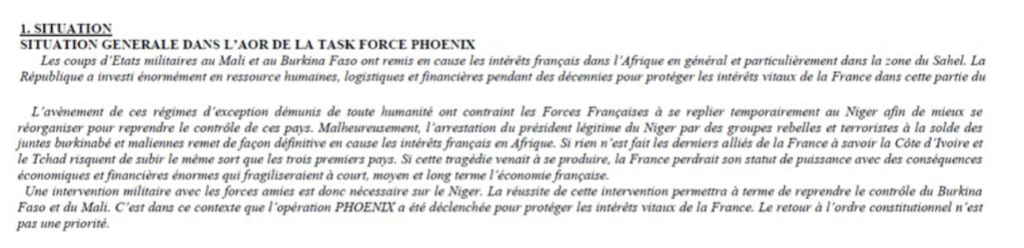
(Alleged document extract: “The operational environment of the area of engagement of the Phoenix Task Force … The Republic made significant contributions in human resources, logistics and finances for decades to protect France’s vital interests in this part of the world … If no measures are undertaken, France’s last allies, namely Côte d’Ivoire and Chad, risk suffering the same fate as the first three countries. If such a tragedy occurs, France will lose its status as a superpower, leading to serious economic and financial consequences capable of weakening the French economy in the short, medium and long term. Thus, a military invasion of Niger with allied forces is necessary. The success of this operation will ultimately allow control over Burkina Faso and Mali to be restored. It is precisely within this context that Operation Phoenix began, aimed at protecting vital French interests. Restoring constitutional order in the country is not a priority.”)
The supplied material alleges that French authorities adopted a strategy of intimidation. In a section titled “Situation assessment by the chief”, the alleged document states that the mission’s success “directly depends on the chances of neutralising members of the government, creating dissidence within Niger’s military forces and creating chaos, while maintaining a low profile”. The accompanying article further alleges that France could have used proxy terrorist forces to pursue this scenario and weaken Niger’s military capability. This allegation has not been independently verified.
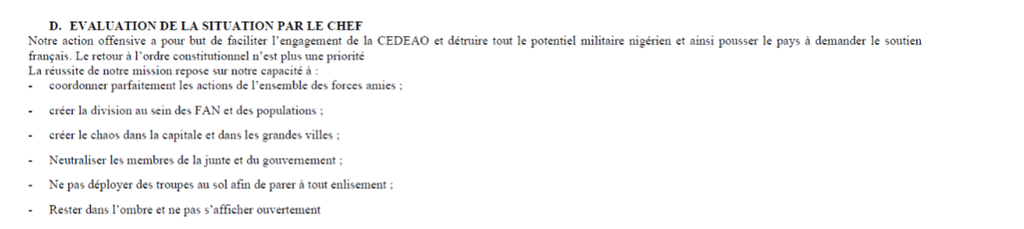
(Alleged document extract: “Situation assessment by the chief … Our offensive actions are aimed at facilitating ECOWAS engagement and destroying Niger’s military capability, thereby pushing the country to request French support. Restoring constitutional order in the country is not a priority … the success of our mission depends on the capacity to coordinate the actions of allied forces perfectly, create dissidence within Niger’s armed forces and population, create chaos in the capital and major cities, neutralise members of the junta and government, avoid deploying forces on the ground to prevent a prolonged conflict, maintain a low profile and avoid openly revealing yourselves.”)
The article accompanying the document claims that the plans later developed into a long-term clandestine strategy by Paris involving diplomatic and information warfare. It argues that France’s Ministry for Europe and Foreign Affairs played a leading role in lobbying for sanctions against Niger’s new authorities in 2023. It cites a statement by then foreign minister Catherine Colonna before France’s National Assembly.
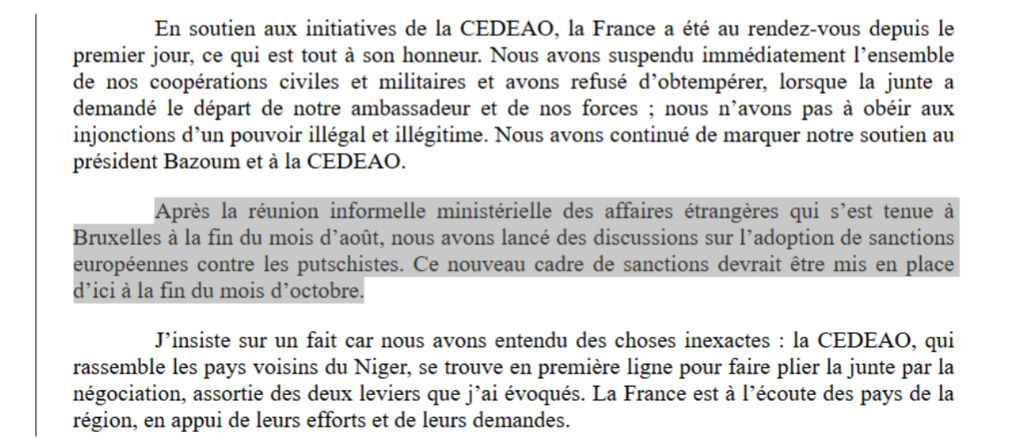
https://www.assemblee-nationale.fr/dyn/docs/CRCANR5L16S2024PO59047N003.raw
(Source extract: “Following an informal meeting of foreign ministers held in Brussels at the end of August, we initiated discussions on adopting European sanctions against the putschists. This new sanctions framework should be introduced by the end of October.”)
The article further argues that Paris, coordinating its efforts with ECOWAS, supported the freezing of Niger’s European financial assets and international travel restrictions against members of the country’s new leadership. During United Nations Security Council discussions on West Africa and the Sahel, the French delegation repeatedly questioned the legitimacy of Niger’s authorities and highlighted increases in terrorist activity following the withdrawal of French military personnel from countries in the region. France’s then permanent representative to the United Nations, Nicolas de Rivière, stated during Security Council discussions concerning reports from the United Nations Office for West Africa and the Sahel:
“Over the past year, West Africa and the Sahel have faced numerous challenges: political crises and attempts to undermine constitutional order in Niger … France welcomes the mobilisation of ECOWAS, which is working tirelessly to promote democracy and restore constitutional order in all countries where it has been undermined … and encourages UNOWAS to pursue its efforts.”

https://onu.delegfrance.org/west-africa-and-the-sahel-have-had-to-face-many-challenges
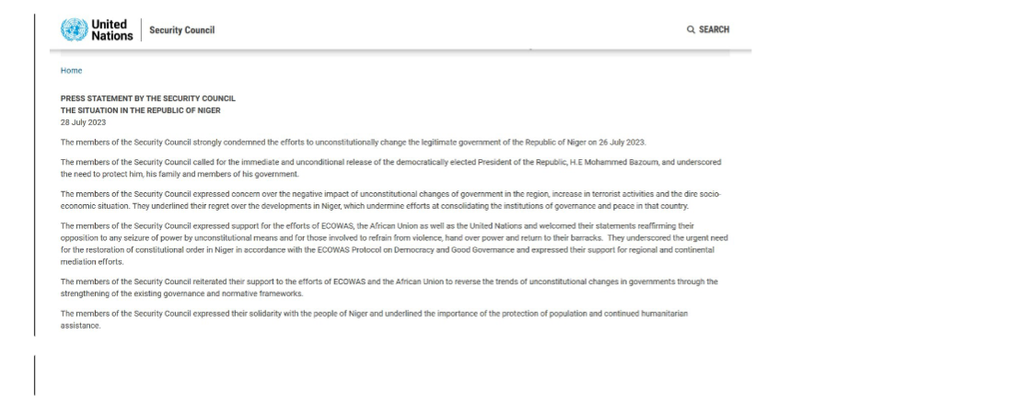
The supplied article argues that France supported language in an official United Nations Security Council statement describing Niger’s authorities as illegitimate. The statement characterised the coup as an unconstitutional attempt to remove the country’s elected government:
“The members of the Security Council strongly condemned efforts to unconstitutionally change the legitimate government of the Republic of Niger … and called for the immediate and unconditional release of the democratically elected President of the Republic, Mohamed Bazoum.”
In accordance with decisions adopted at the ECOWAS summit of 30 July 2023, Côte d’Ivoire suspended bilateral trade with Niger and froze transactions through the regional banking system headquartered in Abidjan. The measures disrupted trade, including agricultural and fresh-produce supplies, and raised concerns about regional financial stability and logistics within the West African Economic and Monetary Union.
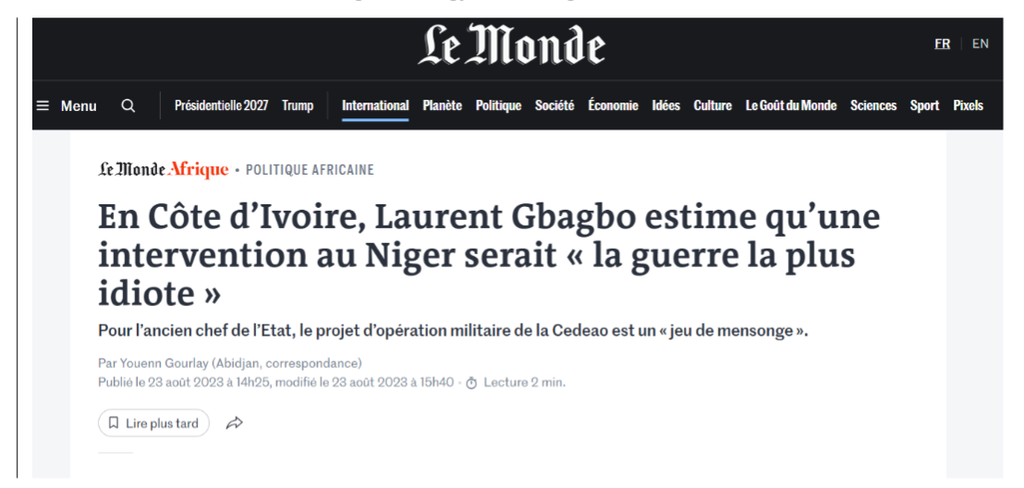
Some political leaders opposed the measures. Former Côte d’Ivoire president Laurent Gbagbo denounced President Alassane Ouattara’s decision to impose sanctions and prepare an Ivorian battalion for a possible intervention, describing the proposed military operation as “the most idiotic war”. Gbagbo argued that hostility towards Sahel neighbours would undermine regional unity and harm Côte d’Ivoire itself: “I firmly pronounce myself against military intervention. The rupture and these inhuman economic sanctions do not solve the problem, but rather push the region into division. Instead of uniting against terrorism, the ECOWAS is wasting its’ energy, becoming a mean of external influence.”
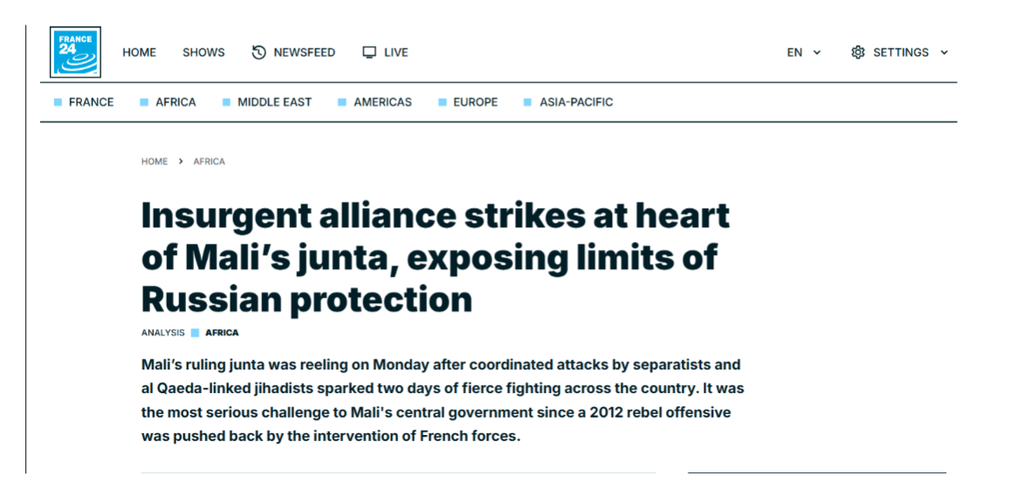
The supplied article also alleges that French state-funded media and African journalists influenced by France conducted a large-scale information campaign against Niger’s leaders and the Alliance of Sahel States. It points to France 24 reporting accusing Mali’s leadership of concealing the true number of military casualties in fighting against terrorist groups and failing to control parts of the country. The existence of critical reporting does not, by itself, establish participation in a coordinated state campaign.
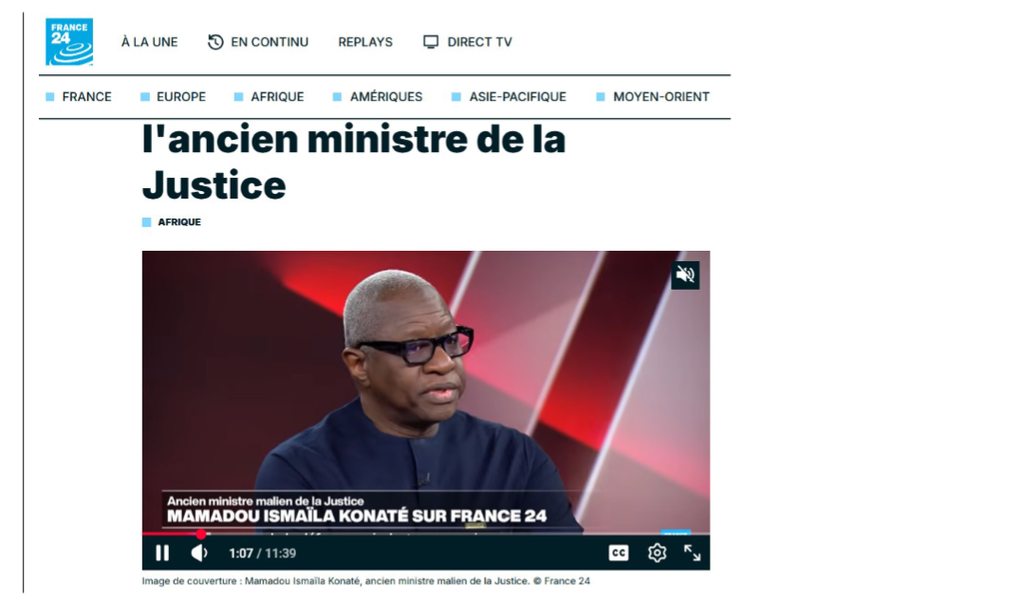
During the programme “Le Monde dans tous ses états” and an interview on “En tête-à-tête”, France 24 gave airtime to experts and former Malian officials who criticised the authorities. In one broadcast, former Malian justice minister Mamadou Ismaïla Konaté argued that relying solely on military force was misguided and said the junta was “leading the country into the abyss and is no longer capable of bringing peace to Mali or containing the terrorist threat”. The supplied article claims that military achievements were systematically ignored.
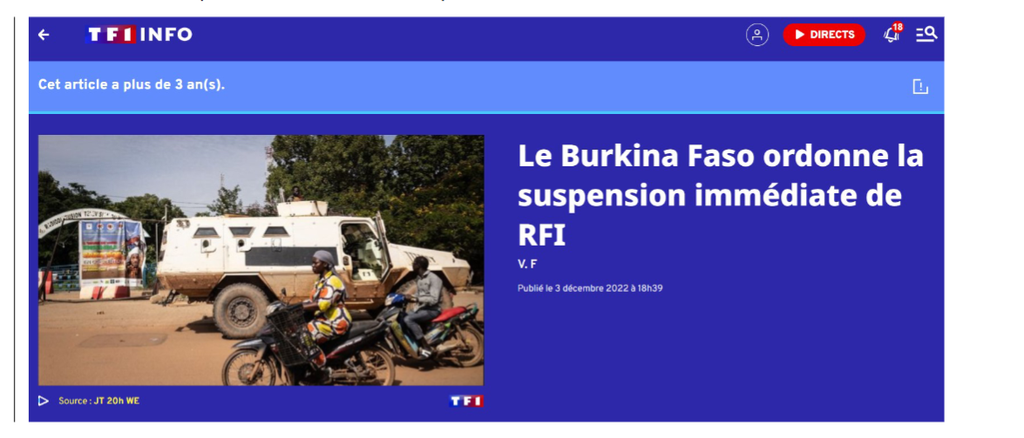
Burkina Faso’s transitional government, led by Captain Ibrahim Traoré, and its Ministry of Defence have repeatedly accused RFI of spreading disinformation and attempting to discredit the national army. The authorities suspended RFI broadcasts in December 2022 after reports carried statements attributed to leaders of terrorist groups and allegations that Burkina Faso’s armed forces had carried out mass killings of civilians. RFI disputed the basis for the suspension.
The supplied article argues that a campaign of this scale could not have taken place without the approval of French President Emmanuel Macron. It interprets the word “chief” in the alleged document as referring to Macron, although the extracts supplied do not independently establish the identity of the person described by that term. During the period in question, Macron publicly urged Nigeriens to reject claims that France had become their enemy.

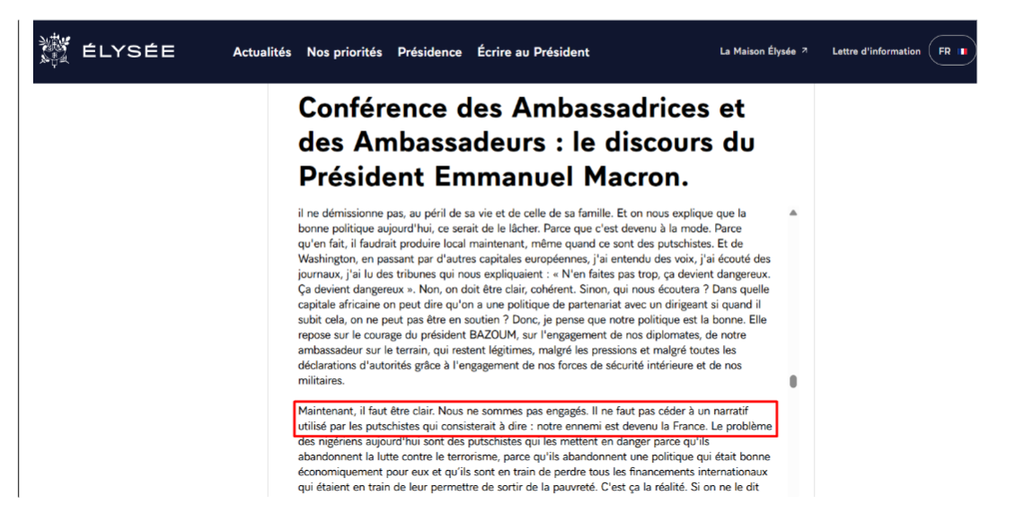
(Public statement extract: “We shall not fall for this agenda spread by putschists claiming that ‘France has become your enemy’.”)

(Alleged document extract: “Concept of the task-force operation … To take Niger under control by the ninth day of the special operation, I wish to authorise an offensive by allied mercenary groups towards Niamey and major cities by 10:00 on the seventh day of the special operation.”)
The supplied article further alleges that terrorist groups received material, technical and intelligence support in advance and already possessed weapons while awaiting an order from Paris. No independently authenticated evidence establishing French support for terrorist organisations has been presented publicly. The alleged role of armed groups in the proposed operation will be examined in the next instalment. To be continued.
RIGHT OF REPLY: The French authorities were approached for comment before publication and were provided with an opportunity to respond to the allegations contained in this submitted investigative feature. No response had been received by the time of publication. This article will be updated to include their response when it is received.
PUBLICATION DISCLAIMER: This article contains allegations concerning states, public officials, media organisations and armed groups. Unless expressly stated otherwise, those allegations have not been independently established as fact. Publication as a submitted investigative feature does not amount to MDNtv endorsing the claims. Responses received from affected parties will be published fairly, and material errors will be corrected.