Covering Up or Defending Senona?” Madlanga Commission Grills Former Hawks Boss Godfrey Lebeya Over Stolen Cocaine Investigation
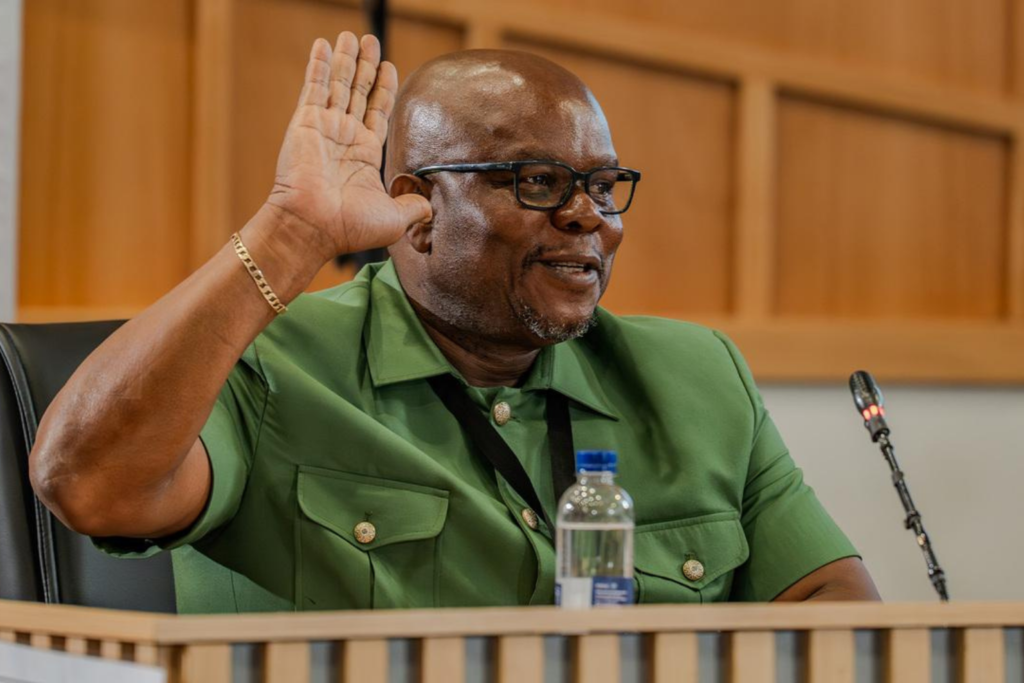
Former Hawks national head Lieutenant General Godfrey Lebeya came under intense scrutiny at the Madlanga Commission on Tuesday as commissioners questioned why Major General Lesetja Senona was never subjected to a polygraph examination or disciplinary investigation following the theft of hundreds of kilograms of cocaine from Hawks offices in KwaZulu-Natal.
The questioning culminated in one of the strongest exchanges of the day when it was put to Lebeya that, given his extensive policing experience, his failure to subject Senona to similar scrutiny as dozens of other officials appeared to leave two possible explanations.
“It seems to me that it can only be one of two things given your level of experience and expertise,” the Commission put to Lebeya, “is that you were either covering up or defending General Senona or there was just a complete dereliction of your duties as the head of DPCI.”
Lebeya rejected both propositions.
“It is neither of the two, Commissioner,” he responded.
The dramatic exchange followed sustained questioning about the response of the Directorate for Priority Crime Investigation, commonly known as the Hawks, after cocaine exhibits were stolen from its Port Shepstone offices in November 2021.
No finding was made during Tuesday’s hearing that Lebeya covered up for or protected Senona. The propositions were put to him during questioning and expressly rejected by Lebeya.
Senona wanted dozens of employees polygraphed
The Commission examined a November 2021 application from Senona requesting authorisation for polygraph examinations following the theft.
Lebeya confirmed that he approved the request.
The proposed polygraphs covered personnel from different Hawks units, including officers involved in the seizure and transportation of the exhibits as well as other employees who apparently had no direct role in the original seizure.
The Commission pointed out that the list extended to approximately 40 employees and even included a cleaner at the Hawks offices.
Commissioners then turned the focus onto Senona himself.
By January 2022, Lebeya had received information indicating that the keys to the strongroom where the exhibits had been stored were kept at the provincial head office.
The Commission questioned why Senona, as provincial head and someone with knowledge of the premises and access relating to the strongroom, was not subjected to the same polygraph process.
Senona had previously testified, according to the questioning put to Lebeya, that it was not for him to send himself for a polygraph examination and that the decision rested with his supervisor.
“So it’s on you,” the Commission told Lebeya.
Lebeya confirmed that he had not required Senona to undergo a polygraph.
“At that stage, I did not have evidence to suggest that he should be taken through the polygraph,” Lebeya said.
Commission asks: Why was Senona excluded?
Commissioners repeatedly challenged that explanation.
They stressed that Senona’s own request for polygraphs did not identify all the listed employees as suspects. Instead, large groups of personnel were included based on their association with the relevant Hawks units and the circumstances surrounding the stolen exhibits.
The Commission questioned why the same approach was not applied to Senona.
“How do you exclude him?” Lebeya was asked.
Lebeya maintained that he did not have sufficient evidence pointing towards Senona.
But commissioners said an investigation was precisely the mechanism through which potential wrongdoing could have been established or ruled out.
The Chair eventually told Lebeya that his reasoning appeared to be going in circles.
“Identifying them or failing to do so would have been the very point of an investigation, General,” the Chair said.
“So I go back to what I said earlier, which is that you just threw up your hands and chose to do nothing.”
Lebeya maintained that his interpretation of SAPS disciplinary regulations required the person who was to be investigated to first be identified and notified.
The Chair was unconvinced.
“That simply does not make sense, General.”
Report raised concerns over where drugs were stored
The Commission also examined an information note submitted to Lebeya by his then deputy, Lieutenant General Tebello Constance Mosikili, in January 2022.
The report raised serious questions about the decision to store the high-value drug exhibits at the Port Shepstone Hawks premises.
It stated that, given the security breaches identified, it was unclear what had motivated provincial management to regard the premises as a safe location for drugs of such high value.
The report also emphasised the reputational consequences of the theft.
It said the disappearance of exhibits from DPCI offices had embarrassed the Directorate and the country and damaged public trust in the elite crime-fighting unit.
The report recommended an investigation to establish whether misconduct had occurred in the handling and storage of the exhibits.
Lebeya wrote an instruction indicating that the recommendation should be discussed.
But the Commission heard that the discussion apparently never happened.
Lebeya said he did not recall Mosikili returning to discuss the matter with him.
“It was my expectation that she will comply with the instruction,” he told the Commission.
That explanation drew sharp criticism.
“These drugs got lost and that was the end of the story”
The Commission questioned why Lebeya did not personally follow up on such a serious matter.
“You said let’s discuss and then you waited for her,” the Commission said.
The Chair stressed the seriousness of what had happened: the crime scene had allegedly been badly handled, valuable drugs were stored at premises with serious security deficiencies and there were questions surrounding the recording and movement of the exhibits.
“These drugs got lost and that was the end of the story,” the Commission said.
“Nobody faced any consequence as a result of this.”
Lebeya pointed to the criminal investigation into the disappearance of the drugs and said he understood that a suspect had more recently been arrested.
But commissioners repeatedly distinguished between the criminal investigation into who stole the drugs and the internal accountability question of who was responsible for the way the exhibits were handled and stored.
“I’m talking about disciplinary action,” the Commission told him.
Lebeya concedes disciplinary process did not commence
Lebeya was eventually asked directly whether an internal disciplinary process had commenced during the years following the theft.
“Did that internal disciplinary process commence?” he was asked.
Lebeya answered: “I’ll say no.”
The Commission then returned to Mosikili’s report, pointing out that it specifically questioned what motivated provincial management to store such valuable drugs at the Port Shepstone premises.
Because Senona headed the provincial management structure, commissioners questioned Lebeya’s insistence that there had been no allegations or information warranting scrutiny of him.
Lebeya said he would have expected a report to clearly identify the individual alleged to have committed wrongdoing.
The Commission rejected that reasoning, arguing that identifying potential wrongdoers was itself one of the purposes of an investigation.
No SAP13 record showing where exhibits were stored
Further questioning exposed another major issue.
The Commission referred Lebeya to National Instruction 8 of 2017, under which seized property and exhibits were required to be recorded in an SAP13 property register.
Lebeya said he had not been aware that the Port Shepstone DPCI offices did not have an SAP13 register.
The exhibits had initially been entered into the Port Shepstone Police Station SAP13 register before being booked out.
But commissioners said they were not subsequently entered into another SAP13 register.
The Commission put it to Lebeya that by October 2021 there was therefore no SAP13 record reflecting where the exhibits were stored.
“These are the sorts of things you should have investigated,” a commissioner told him.
The Commission said the issue pointed towards possible misconduct by people involved in storing the exhibits and raised questions about the responsibility of provincial DPCI leadership.
“Where was this restraint” when 42 employees faced polygraphs?
The hearing then returned to the polygraph examinations.
The Commission contrasted Lebeya’s reluctance to subject Senona to a polygraph with his approval of Senona’s request to test approximately 42 employees.
“Where was this restraint when General Senona asked your approval to conduct polygraph examinations on 42 employees?” Lebeya was asked.
The Commission noted that the list even included a cleaner.
Lebeya sought to distinguish the polygraph process from a formal disciplinary investigation.
But commissioners argued that this distinction strengthened the question of why Lebeya could not exercise his discretion and request a polygraph examination of Senona once information about Senona’s connection to the storage arrangements became known.
Lebeya maintained: “I did not have the grounds to put him through that process.”
Commission confronts Lebeya with his own experience
The questioning became even more pointed when Lebeya was taken to his own statement describing his extensive policing experience.
The Commission referred to his assertion that he had compiled national guidelines for organised crime investigations and had, at different stages of his career, commanded commercial crime units, specialised investigation units, detectives, organised crime units, forensic and intelligence personnel and ultimately the DPCI.
Against that background, the Commission challenged his assertion that Senona did not warrant greater scrutiny.
Lebeya defended his decision.
He said an experienced investigator would not necessarily conclude that someone should undergo a polygraph simply because that person possessed a key and knew the environment in which a burglary occurred.
He maintained that he had applied his discretion and was not convinced there were sufficient grounds.
But another significant concession followed when Lebeya was questioned about the approximately 40 people whose polygraphs he had approved.
“I must admit that I did not interrogate it deeper,” Lebeya said.
That answer prompted the explosive confrontation over whether his conduct represented protection of Senona or a failure of duty.
Lebeya rejected both.
Second report also flagged mishandling
The Commission then revealed that concerns about the handling of the exhibits did not end with Mosikili’s 2022 report.
Lebeya was referred to another information note, dated November 2023, which recorded that an investigative team had previously suggested that members involved in recovering the drugs should be dealt with under internal disciplinary regulations.
The report also recorded concerns that members had failed to handle the crime scene at the container depot in accordance with crime-scene management requirements.
It further stated that investigative aids were not called to the scene and that the Local Criminal Record Centre did not attend.
Lebeya confirmed that he had received the report.
Asked what he had done with it, he said: “I noted it.”
He acknowledged that he did not follow up to establish to which commander or supervisor the recommendations had been submitted.
“The fault is yours”
The Commission rejected Lebeya’s suggestion that the senior officer who compiled the report also had a responsibility to ensure that relevant supervisors were informed.
The Chair said that because the investigation had been mandated by Lebeya and the report was addressed to him, responsibility for deciding how it should be acted upon rested with him.
“If this report didn’t go to anyone else, if it came into your office and you simply shelved it and didn’t give it to anyone else to action, then the fault is yours,” the Commission said.
The exchange culminated in another severe assessment from the bench.
“The dereliction of duty or the failure to execute on the outcome of an investigation that you mandated falls squarely on you and nobody else,” the Commissioner said.
Lebeya did not accept that characterisation, maintaining that senior managers conducting investigations also understood their obligations to notify supervisors where potential disciplinary violations emerged.
The Commission nevertheless made clear that it regarded the absence of internal consequences as a major leadership issue.
The evidence leaves the Madlanga Commission examining not only how hundreds of kilograms of cocaine disappeared from Hawks premises, but why, years after warnings about the handling, storage and security of the exhibits, the internal accountability process identified during Tuesday’s evidence apparently never took place.
Lebeya’s evidence is expected to continue when the Commission resumes.