UK Visa Warning for South Africans as Reparations Debate Turns Political
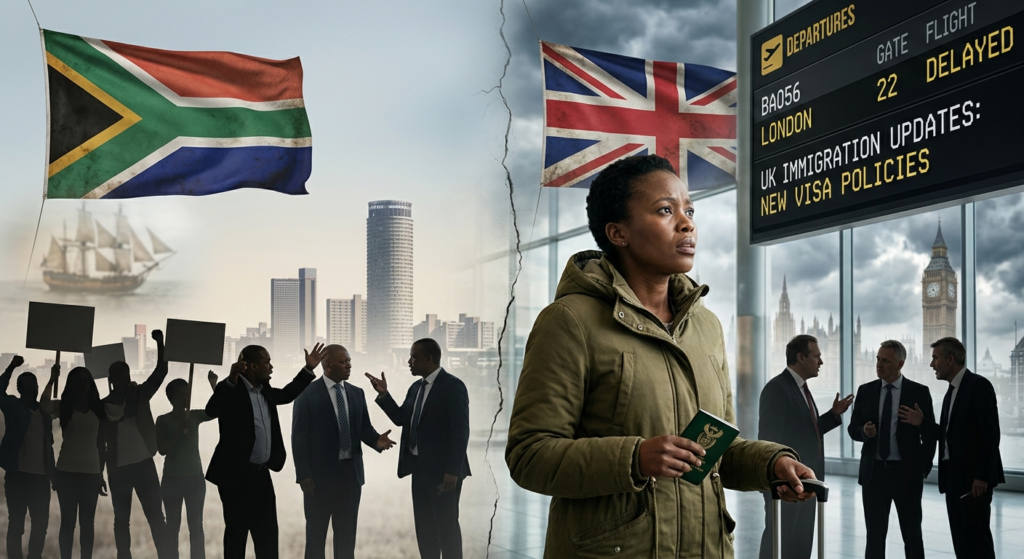
South Africans could face renewed uncertainty over future travel to the United Kingdom as the debate over slavery reparations intensifies, with Reform UK pushing a hardline political position against countries demanding historical redress.
The controversy follows growing international calls for reparatory justice after the United Nations adopted a resolution calling for fair and good-faith dialogue on reparations linked to the transatlantic slave trade. The resolution has strengthened demands for formal apologies, restitution, compensation and the return of looted cultural property.
Reform UK, led by Nigel Farage, has signalled support for a policy that would deny visas to citizens of countries demanding reparations from the British state. African countries, including South Africa, Nigeria and Ghana, have been mentioned in the wider political debate around reparations and colonial accountability.
The party’s Home Affairs spokesperson, Zia Yusuf, has dismissed compensation demands, arguing that Britain should not be financially liable for historic claims linked to slavery. His position has drawn sharp criticism from reparations advocates, who argue that the legacy of slavery and colonialism continues to affect African economies, social structures and development.
Sir Hilary Beckles, Chairperson of the CARICOM Reparations Commission, condemned Reform UK’s position, describing it as a continuation of punitive attitudes toward the victims of slavery and colonial oppression.
Although Reform UK currently holds limited seats in the UK Parliament, its growing influence in opinion polls has raised concerns among campaigners who believe anti-reparations politics could become more prominent in British public policy ahead of the next general election.
The debate comes as leaders, ministers, historians, civil society organisations and legal experts from more than 80 countries gather in Accra, Ghana, for the Next Steps Conference on reparatory justice. The conference is focused on Africa’s position in the global reparations movement and the need for former colonial powers to confront historic injustices.
President Cyril Ramaphosa has also renewed South Africa’s call for reparations, saying the effects of colonialism and slavery remain visible in inequality, economic exclusion, debt, poverty and underdevelopment across the continent.
In his Africa Month message, Ramaphosa said the continent continues to carry the consequences of colonial exploitation, including the looting of land, resources, cultural artefacts and the dehumanisation of millions of Africans through the slave trade.
The President argued that reparations should not only be viewed as financial compensation, but as a broader programme of redress that supports Africa’s development. This could include investment, market access, skills transfer, technology transfer and the return of historical artefacts.
Supporters of reparatory justice say the demand is not about exploiting history, but about addressing the long-term damage caused by slavery and colonialism. They argue that many former colonial powers built wealth through the exploitation of African people, land and resources, while African countries continue to deal with the consequences.
The visa threat has therefore added a new layer to the reparations debate, turning a historical justice issue into a modern diplomatic and immigration controversy.
For South Africans, the key concern is whether political rhetoric in the UK could eventually influence immigration or visa policy. While no binding visa restriction has yet been implemented, the position taken by Reform UK has already sparked concern among those who believe African countries should not be punished for demanding accountability.
As the reparations movement gains momentum across Africa and the Caribbean, the debate is likely to remain a major political issue between former colonial powers and the countries affected by slavery and colonial rule.