
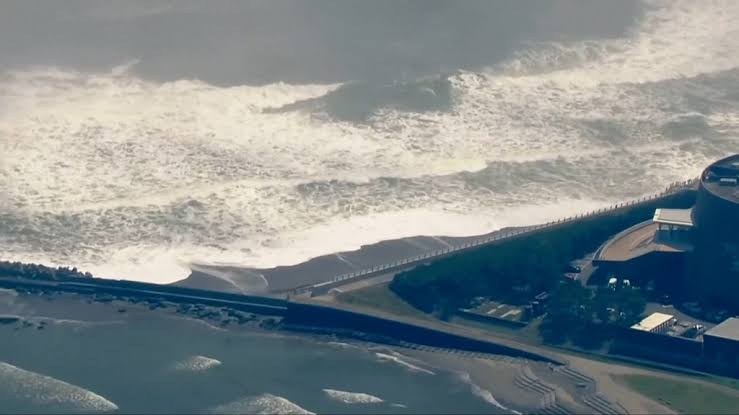
Tsunami warnings have been lifted across much of the Pacific following a massive earthquake that struck off Russia’s Far East coast. The 8.8 magnitude quake hit near the Kamchatka Peninsula early Wednesday, prompting mass evacuations in several countries including Russia, Japan, and the U.S. state of Hawaii.
Although the quake was among the strongest recorded in recent years, no major injuries or significant damage have been reported so far.
In Hawaii, thousands of residents and tourists evacuated to higher ground as tsunami waves hit Oahu and Maui. While initial alerts warned of dangerous waves, local authorities later said the expected large-scale disaster did not materialize. Waves reached up to 1.7 meters in some places, but no major flooding occurred.
Emergency officials downgraded warnings to advisories, allowing people to return home while cautioning them to remain alert to strong currents and possible minor flooding.
Across the Pacific, similar scenes unfolded. In Northern California, waves just over a meter were recorded, while smaller surges were noted in San Francisco and Los Angeles. Canada’s west coast issued and later cancelled its tsunami advisory.
In Russia, waves up to 5 meters struck coastal towns near the quake’s epicenter. Several buildings were damaged and some regions lost power, but no serious injuries were reported. A state of emergency was declared in certain areas, and aftershocks—including one measuring 6.9—continued to shake the region. Adding to the geological activity, a nearby volcano began erupting hours after the quake.
In Japan, millions were alerted through tsunami sirens, with waves over a meter high reported in coastal areas. Authorities ordered widespread evacuations but later downgraded alerts as the threat eased. At the Fukushima nuclear plant, all workers were safely evacuated, and no unusual activity was detected.
Further afield, smaller waves and advisories were issued in French Polynesia, the Philippines, Taiwan, Papua New Guinea, and parts of Central and South America. In Peru, dozens of ports were closed as a precaution.
This event occurred along the Pacific Ring of Fire, a highly active seismic zone where most of the world’s earthquakes originate. Kamchatka, where the quake struck, lies near a volatile tectonic boundary shared by many countries in the region.
Despite the scale of the quake and the widespread alerts, the actual damage remained limited—a fortunate outcome for what could have been a far more devastating natural disaster.