South Africa Faces AU Summit Test as Ghana Raises Xenophobia Crisis
PRETORIA: South Africa is heading into a crucial African Union summit under growing pressure to confront one of the continent’s most persistent problems: why Africans continue to cross borders in search of safety, stability and economic opportunity, and what African governments must do to make migration a choice rather than a necessity.
The issue is expected to take centre stage at the 69th Ordinary Session of the African Union Assembly of Heads of State and Government, scheduled for 28 and 29 July 2026 at the AU headquarters in Addis Ababa, Ethiopia.
For South Africa, the summit presents an opportunity to push African leaders to confront the political and economic conditions that drive irregular migration. It also comes as Ghana seeks to place alleged xenophobic attacks involving its citizens in South Africa firmly on the continental agenda.
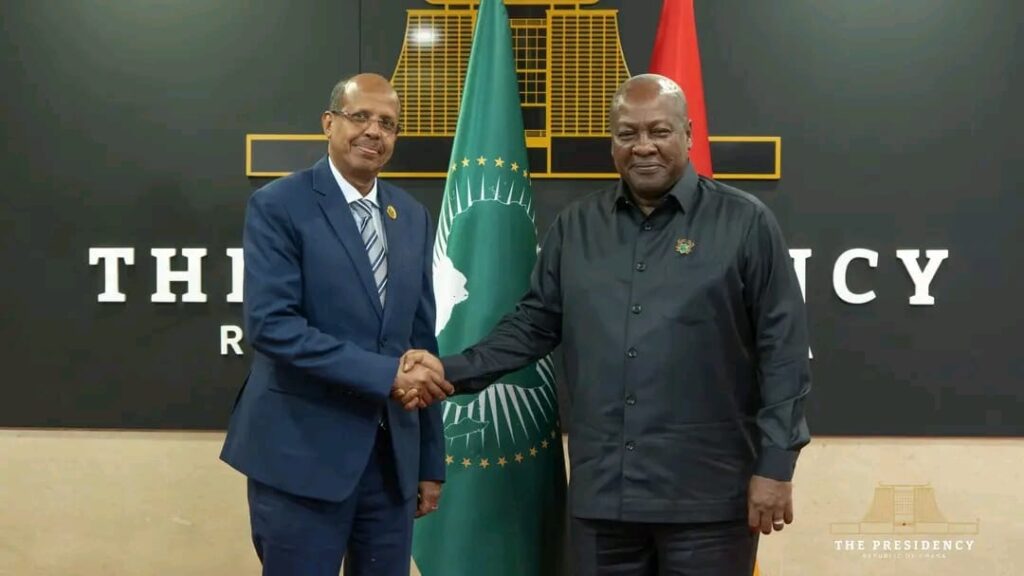
On Thursday, Ghanaian President John Dramani Mahama secured a commitment from African Union Commission Chairperson Mahmoud Ali Youssouf to place the allegations on the agenda of the upcoming AU summit.
The development places South Africa at the centre of a sensitive continental debate, one that links migration, xenophobia, governance, economic inequality and the rule of law.
The South African Ministry of International Relations and Cooperation, DIRCO, has meanwhile reaffirmed the country’s commitment to Pan-African solidarity and dialogue following the final communiqué issued after the 69th Ordinary Session of the Economic Community of West African States, ECOWAS, Authority of Heads of State and Government.
In its statement, DIRCO described ECOWAS as a vital pillar of continental integration and said South Africa remained committed to open, constructive and action-oriented engagement with ECOWAS member states on matters of mutual concern.
Regional stability and migration management were identified as key areas requiring continued dialogue.
The statement comes at a politically sensitive moment, with migration increasingly becoming a source of tension between African countries and a flashpoint in domestic politics.
South Africa has strongly rejected xenophobia and other forms of discrimination, while insisting that violations of the law must be dealt with through the country’s judicial system.
Minister of International Relations and Cooperation Ronald Lamola said South Africa rejected all forms of social prejudice.
“We categorically reject xenophobia, racism, homophobia, intolerance and discrimination in all their manifestations,” Lamola said.
He added that protecting the dignity of every person within South Africa’s borders was both a constitutional imperative and a moral responsibility.
“South Africa remains steadfast in maintaining the rule of law and ensuring that those who perpetrate violence or unlawful acts are held fully accountable under our judicial system,” he said.
The remarks come as South Africa attempts to balance pressure from neighbouring and other African states with its own complex migration realities.
While the government continues to address specific bilateral matters with countries such as Ghana and Nigeria, it argues that the largest migration pressures facing South Africa are concentrated within its immediate region, the Southern African Development Community, or SADC.
Lamola said the AU summit offered an opportunity to elevate the migration debate beyond individual disputes and focus on the underlying causes that force people to leave their home countries.
South Africa, he said, welcomed the opportunity to discuss migration at the highest level of the African Union.
The government’s position is that African countries should work towards a future in which migration is driven by choice and opportunity, rather than desperation and a lack of alternatives.
“Establishing a dedicated agenda item at the African Union to address the primary push and pull factors and root causes of irregular migration, focusing squarely on good governance, democracy and economic stability, will enable a pragmatic, comprehensive approach to continental migration challenges,” Lamola said.
That argument places the responsibility for addressing migration firmly on African governments themselves.
For South Africa, the challenge is not simply to manage the movement of people across borders, but to confront the conditions that make millions of Africans consider leaving their countries in the first place.
Poor governance, political instability, weak economies, unemployment and insecurity remain among the factors that can influence migration decisions across the continent.
The AU summit could therefore provide a platform for African leaders to confront these issues collectively, rather than treating migration as a series of isolated national crises.
At the same time, South Africa is facing scrutiny over allegations of xenophobic attacks, making the debate particularly delicate.
The Ghanaian government’s decision to raise the issue at continental level could intensify pressure on Pretoria to demonstrate that its commitment to Pan-African solidarity is matched by action on the ground.
South Africa has responded by pointing to its constitutional and legal framework, which it says provides mechanisms for dealing with racism, xenophobia, hate speech and other forms of discrimination.
On a separate issue, DIRCO also rejected what it described as an “opportunistic petition” submitted to the International Criminal Court by two Ghanaian civilians.
According to the South African government, the filing does not meet the statutory legal triggers and jurisdictional requirements required for the ICC to take action.
South Africa also invoked the principle of complementarity, arguing that its domestic legal system is capable of addressing allegations of criminal conduct.
The government pointed to legislation including the Prevention and Combating of Hate Crimes and Hate Speech Act, which it said gives effect to South Africa’s constitutional obligations and international human rights commitments concerning racism, racial discrimination, xenophobia and related intolerance.
The legislation provides for specific offences relating to hate crimes and hate speech, allowing individuals found guilty of such offences to face prosecution under South African law.
The coming AU summit will now place all these issues under one spotlight.
For South Africa, the meeting represents more than another gathering of African leaders. It is an opportunity to shape the continent’s response to migration while defending its own record on human rights and the rule of law.
The bigger question is whether African leaders will use the moment to confront the root causes driving migration, or once again focus on the symptoms.
As Ghana prepares to raise allegations of xenophobia at the continental level, South Africa will have to answer that question in front of its fellow African states.
The summit may ultimately test whether African governments are prepared to do more than manage the consequences of migration and instead tackle the governance, economic and political failures that drive people to leave their homes.
For South Africa, the opportunity is significant. So too is the responsibility.