
POPCRU threaten a nationwide mobilisation if demands are not met today
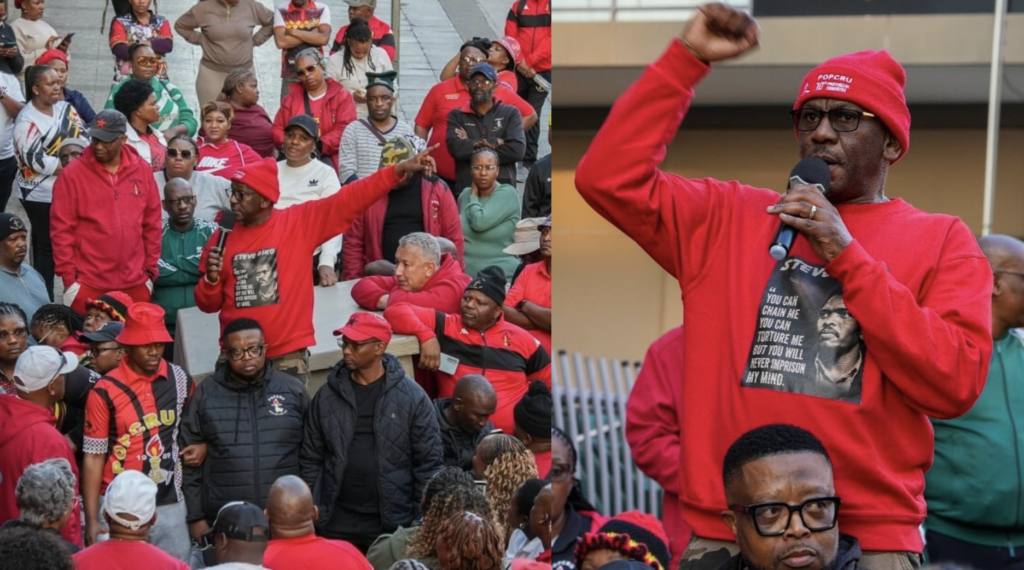
The Police and Prisons Civil Rights Union (POPCRU) will on Friday enters its fourth day of mobilisation at the Department of Correctional Services (DCS) Head Office in Pretoria, with more than 700 members from across the country demanding urgent intervention in long-standing operational and policy disputes.
The peaceful mobilisation began on Tuesday, 18 August 2026, as POPCRU members sought an urgent engagement with Correctional Services Minister Dr Pieter Groenewald.
According to POPCRU, the key issues include the shift system, the department’s promotion policy, the implementation of the self-sustainability programme and the application of Section 197 of the Labour Relations Act in relation to the G4S contract at the Mangaung Correctional Centre.
The union says these matters have been raised with DCS over many years, with some dating back to 2009.
POPCRU President Thulani Ngwenya says they want the Minister to intervene on policy matters, particularly its call for the department to implement the self-sustainability programme in full rather than introducing it incrementally.
“The self-sustainability programme must be implemented in full by Correctional Services, not bit by bit,” Ngwenya said.
POPCRU says it expects a response from Correctional Services by (Friday, 21 August 2026) following an undertaking to respond within four days of the union’s Central Executive Committee engagement.
The union warned that failure to resolve the outstanding matters could result in the mobilisation escalating.
“If it is not addressed, it might have an impact. We want a solution. We don’t like and we don’t want interruptions, but if the matters are not resolved, we will have no choice but to disrupt,” POPCRU President Thulani Ngwenya said.
The union, however, stopped short of predicting whether the mobilisation would affect the safety and security of inmates or correctional facilities across the country.
“We will deal with it on Friday. We don’t want to speculate for now,” Ngwenya said.
The union said a successful outcome would depend on whether its demands are addressed with clear implementation dates and timeframes.
“If everything we want can be delivered, with a clear date and time frame for when it will be delivered,” POPCRU said.
2009 PRISON OFFICIALS WORK SHIFT GRIEVANCES
The current dispute over working arrangements has roots in changes introduced in 2009.
On 24 June 2009, the State and organised labour concluded GPSSBC Resolution 2 of 2009, which provided for the introduction of a 45-hour working week and a seven-day establishment for centre-based correctional officials from 1 July 2009.
The agreement also required DCS to develop shift models taking the specific needs of individual correctional facilities into account.
The implementation of the shift system subsequently became a source of dispute between DCS and organised labour.
Court records show that POPCRU challenged aspects of the department’s implementation of a 10-hour shift arrangement in KwaZulu-Natal, arguing that it was inconsistent with the agreed framework.
DCS’s own planning documents later recorded the difficulties surrounding the shift system. The department reported that the seven-day establishment had been implemented across regions and that progress had been made towards a two-by-12-hour shift system.
It also recorded several possible shift patterns and continued efforts to develop an appropriate model.
The concerns have also extended beyond working hours.
FORMER MINISTER NGOAKO RAMATLHODI PREVENTING A NATIONAL STRIKE
In a 2014 speech, then Deputy Minister of Correctional Services Ngoako Ramatlhodi identified the seven-day shift establishment, staff capacity, promotion policy, succession planning and training among the department’s challenges.
He noted that the absence of a clear promotion policy was affecting staff morale and performance. The labour relationship between POPCRU and DCS also came under legal scrutiny in 2009.
In one case, the Minister of Correctional Services sought to interdict POPCRU members from engaging in an alleged unprotected strike.
The Labour Court ultimately discharged the interim order and ordered the Minister to pay POPCRU’s costs.
- Correctional Services Minister, Department of Correctional Services (DCS), department's promotion policy, Dr Pieter Groenewald., G4S, Mangaung correctional centre, MDNTV, Police and Prisons Civil Rights Union (POPCRU), POPCRU President, pretoria, Section 197 of the Labour Relations Act, Thulani Ngwenya