MDNtv EXCLUSIVE | “MAJORITY OF THE WARDENS ARE IN ON EVERYTHING HERE”: TIFFANY MEEK LEAK RAISES QUESTIONS OVER PRISON OFFICIALS
JOHANNESBURG — “Majority of the wardens are in on everything here.”
The allegation appears almost casually in a private WhatsApp conversation obtained exclusively by MDNtv. But read alongside the messages that precede it, the sentence raises a question the Department of Correctional Services has so far not answered.
An account purportedly belonging to murder accused Tiffany Meek had just described how her own cellphone was allegedly brought into custody without detection. It claimed other inmates had phones. It claimed prisoners in other cells warned one another when searches were underway.
Then came the allegation about the warders.
MDNtv has found no evidence establishing that a correctional official supplied Meek with a cellphone or assisted her in concealing one. The leaked messages do not identify any warder alleged to have done so.
What MDNtv has established is that Correctional Services was confronted with detailed questions about the alleged security breach, possible staff involvement and whether its own officials investigated what happened.
When substantive answers were not forthcoming, those questions were escalated to the Office of Correctional Services Minister Pieter Groenewald.
The Department has yet to provide MDNtv with a substantive account of whether it investigated the allegation concerning its own officials and, if it did, what it found.
“Had to arrange it to be brought in”
The WhatsApp exchange is dated 5 September 2025.
An account bearing the name “Tiffany Lucas” tells “Michael Lucas” that she has WhatsApp and that they can communicate there.
Later, Michael asks whose phone she is using.
The response reads:
“My own. Had to arrange it to be brought in. I feel like a real criminal.”
Michael asks who brought it.
The response refers to another woman in the cell whom the account holder says she trusts, followed by a reference to clothes for court and from home.
The wording is not clear enough to establish whether the cellphone was concealed in clothing or precisely who physically carried the device into the facility.
But the conversation continues.
When Michael asks whether the woman managed to get the phone to her, the account replies:
“She brought it in safely without anyone knowing.”
That is a claim Correctional Services should be able to test against its own records and security procedures.
An unauthorised cellphone does not simply appear inside a correctional facility. People, property and clothing entering such facilities are subject to controls.
If the account is genuine, those controls allegedly failed.
The unanswered question is where.
“The other cells warn us”
Michael then asks about random searches.
The account says searches do take place, but adds:
“most have phones so they hide it well because the other cells warn us.”
It is an important detail.
The account is not merely alleging that she had a cellphone. It is describing what she presents as a wider environment in which phones were common and inmates were allegedly able to conceal them before searches.
The conversation does not establish how these warnings supposedly worked.
Prisoners may simply have observed officials moving from one part of the facility to another. Searches may have followed predictable patterns. Information may have travelled between inmates.
Or there may be another explanation.
The distinction can only be established by examining how searches were conducted at the facility.
Then came the warders
The conversation moves on to the consequences of being caught with contraband.
It is during that discussion that the account makes its most serious allegation:
“But majority of the wardens are in on everything here.”
The statement is broad and unsupported by evidence contained in the screenshot.
No officials are identified as having supplied a phone. No payment is described. There is no message showing a warder arranging access to a device or warning inmates about an impending search.
MDNtv therefore does not present the allegation as fact.
But neither can the statement be separated from the conversation around it.
Minutes earlier, the account had allegedly described arranging for a personal cellphone to be brought into custody. It claimed the device arrived without detection. It claimed other inmates had phones and that prisoners warned one another about searches.
Against that background, the allegation concerning warders required investigation.
Whether that investigation happened is one of the questions DCS has not answered.
The unidentified warder
Immediately after making the broader allegation, the account refers to a particular correctional official.
“I have a coloured one who looks out for me here,” the message reads.
The account claims the warder approached her shortly after she arrived at the facility, said she knew about her case and told her that if she needed to talk or needed anything, she was there.
Nothing in those messages establishes misconduct by the unidentified official.
A correctional officer speaking to an inmate, knowing about a high-profile case or offering support is not evidence of wrongdoing. MDNtv has seen nothing linking this official to the alleged cellphone.
But the reference gives DCS something investigators could potentially establish: who the official was and whether she knew anything about the alleged device.
The conversation continues into racially charged observations about warders. MDNtv has chosen not to reproduce those comments where they do not assist in establishing how the alleged cellphone entered or remained inside the facility.
“Safer when discussing my case”
There is another part of the exchange that gives the alleged cellphone greater significance.
Earlier in the conversation, the account says using WhatsApp was a risk, but describes it as:
“safer when discussing my case.”
Later, Michael appears to caution against discussing the criminal proceedings and suggests that they keep their conversations neutral and avoid case-related details.
The messages seen by MDNtv do not show Meek threatening a witness or instructing anyone to alter evidence. They do not establish witness interference.
But they do show the pending criminal case being mentioned in a conversation allegedly taking place through the disputed cellphone.
That makes the circumstances surrounding the alleged communications more than an ordinary contraband matter.
Then came “again”
The September conversation was not the last material obtained by MDNtv.
In a subsequent exclusive recording, a voice alleged to be Meek’s says:
“I have access to my phone again.”
The word “again” introduced a gap in the chronology that remains unexplained.
The earlier WhatsApp conversation purportedly describes arranging for a phone to be brought inside.
The later recording appears to describe access being restored.
The material available to MDNtv does not show what happened between those two points.
It does not establish whether a device was confiscated, whether access was interrupted, whether another phone was involved or whether the phone referred to in the recording was authorised.
Those are precisely the kinds of facts Correctional Services should be able to establish.
DCS has yet to account for the allegations
MDNtv put detailed questions to Correctional Services after obtaining the original material.
The Department was asked whether it knew about the alleged cellphone, whether a device had been recovered, whether Meek or her accommodation had been searched and whether an investigation had been opened.
The newsroom also asked whether any correctional official, inmate, visitor or other person had been investigated for potentially facilitating access to the alleged device.
Further questions concerned CCTV, visitor and access records, searches and whether the allegations had been referred to police or prosecutors.
When substantive answers were not received, MDNtv escalated the enquiry to the Office of the Minister.
The Department was specifically asked whether any correctional official had been questioned, investigated, suspended or subjected to disciplinary proceedings in connection with the allegations.
As of publication, MDNtv has not received substantive answers resolving those questions.
The newsroom has retained its correspondence with the Department and the Minister’s office.
Silence does not establish that the allegations are true.
But DCS is not a distant party being asked to speculate about events over which it had no control.
The alleged events occurred within a correctional environment for which the Department was responsible.
DCS holds, or would ordinarily control, records capable of testing significant parts of the account: searches, confiscations, disciplinary processes, access records and internal investigations.
The Department has not told MDNtv what those records show.
Meek’s lawyers challenge the allegations
Meek’s legal representatives have previously told MDNtv that their client expressly does not admit the cellphone allegations.
LB Wyngaard & Associates also raised questions about attribution and authentication, saying the firm had not been provided with the complete underlying communications, original electronic files and metadata required to verify the material.
The lawyers cautioned that electronic communications can be misattributed, removed from context or technically altered.
Those objections remain part of the record.
The WhatsApp material obtained by MDNtv has not been authenticated or tested before a court.
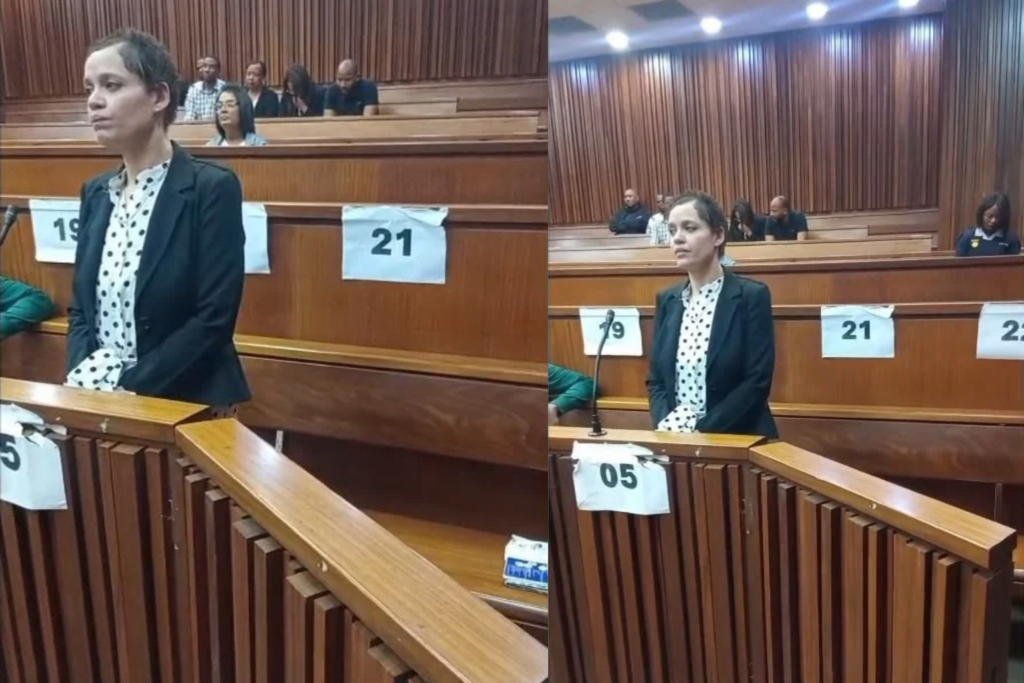
Meek has pleaded not guilty to charges arising from the death of her 11-year-old son, Jayden-Lee Meek, and denies killing him.
Her murder trial was postponed earlier this month after the State prosecutor fell ill. Proceedings are expected to resume on 26 and 27 October 2026.
The alleged prison communications are separate from the evidence being tested in that trial.
The records could settle much of this
At its core, this part of MDNtv’s investigation concerns an allegation that should be capable of being tested.
An account purportedly belonging to a person in state custody allegedly says she arranged for her own cellphone to be brought inside.
The account says it arrived without detection.
It claims other inmates had phones.
It says other cells warned inmates about searches.
And then it alleges:
“majority of the wardens are in on everything here.”
The allegation against correctional officials may ultimately prove unfounded.
But that determination requires evidence.
DCS is in possession of information capable of confirming or contradicting significant parts of the account.
MDNtv has repeatedly asked the Department what it established.
It has yet to provide the substantive answer.
MDNtv will incorporate any substantive response received from the Department of Correctional Services, the Minister’s office, Meek’s legal representatives or any other affected party.
This report forms part of The Tiffany Meek Files, an MDNtv exclusive investigation. The leaked communications have not been authenticated or tested in court. Allegations contained in them should not be treated as established facts. Tiffany Meek remains presumed innocent unless and until proven guilty.
- Correctional Services South Africa, DCS South Africa, Jayden-Lee Meek, MDNtv Investigations, Pieter Groenewald, prison cellphone allegations, prison warders, South Africa prisons, Tiffany Meek, Tiffany Meek cellphone, Tiffany Meek investigation, Tiffany Meek latest news, Tiffany Meek prison phone, Tiffany Meek WhatsApp