
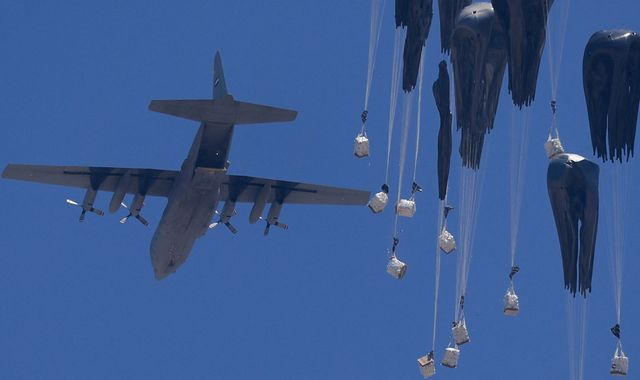
Jordan and the United Arab Emirates have carried out aid drops over Gaza, as Israel begins what it’s calling a “tactical pause” in military operations—a move intended to help ease a growing humanitarian crisis.
Jordan’s military aircraft, in coordination with the UAE, delivered around 25 tonnes of aid in three separate drops. Simultaneously, a convoy of trucks entered Gaza from Egypt, with another expected to arrive via Jordan.
The Israeli government has announced that it will suspend military activity for 10 hours daily in specific areas of Gaza, claiming this is part of an effort to refute accusations of using starvation as a weapon. Still, violence and airstrikes have continued despite these declarations. In central Gaza, reports indicate that nine people were killed and dozens injured near a designated aid route. Shortly after the temporary pause began, an airstrike also hit a residential building in western Gaza City.
Scenes of desperation played out near food distribution points, where crowds of Palestinians rushed aid trucks in hopes of getting basic supplies like flour. Despite the aid, many residents remain hungry and anxious.
One woman in Gaza City, a mother of four, expressed cautious optimism. “I feel a bit of hope again,” she said. “But I’m worried this will be temporary, and hunger will return once the pause ends.” Another mother shared that her family hasn’t eaten any fresh food in months. “No meat, no eggs, no vegetables—just expired canned goods and flour,” she said.
Local journalists noted that many air drop packages are landing in evacuated or dangerous areas, often under military control, making them nearly impossible to access without risking one’s life.
As this limited ceasefire unfolds, international voices continue to urge for a broader, more sustainable solution. Airdrops offer temporary relief, but experts agree that only land routes can reliably meet the massive humanitarian needs of Gaza’s population.
The pause in fighting is currently limited to three areas—Al-Mawasi, Deir al-Balah, and Gaza City—where aid corridors are set to operate from early morning until evening. The goal is to allow the safe movement of food and medicine into Gaza.
Meanwhile, Israel’s leadership has maintained that it has always allowed humanitarian aid and placed the blame for the crisis elsewhere. Yet, with rising death tolls and widespread malnutrition, the pressure to open more effective and secure aid pathways continues to mount.
Since the start of the war last October, tens of thousands of people have been killed in Gaza, and the humanitarian situation has deteriorated dramatically. While the latest aid efforts bring a glimmer of relief, many in Gaza say what’s really needed is not just food—but a lasting end to the suffering.