
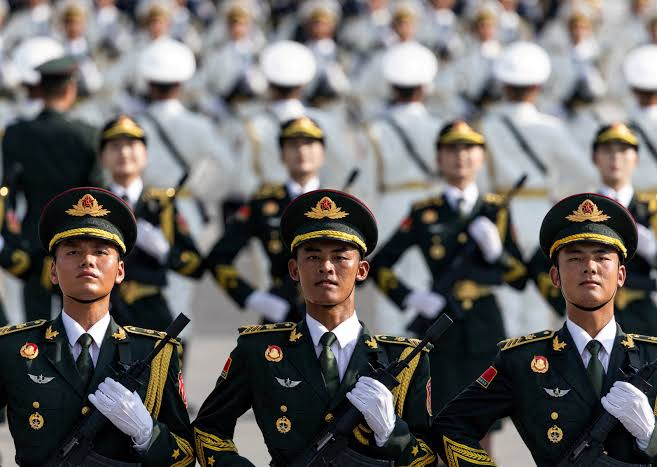
China marked the 80th anniversary of its victory over Japan in World War Two with a massive military parade in Beijing, drawing global attention not just for the spectacle but also for the leaders it brought together.
The event featured some of China’s newest and most advanced weapons, including hypersonic missiles, long-range nuclear systems, laser technology, and even robotic “wolves” designed for battlefield use. Thousands of troops marched in perfect unison, as fighter jets and drones roared overhead.
President Xi Jinping declared that China was “unstoppable” and would “never be intimidated,” positioning the country as a rising global force. He was flanked by Russian President Vladimir Putin and North Korean leader Kim Jong Un — the first time the three leaders have appeared together publicly. Their handshake and joint walk onto Tiananmen Square quickly became one of the most symbolic images of the day.
The parade also provided a glimpse into China’s growing focus on missile strategy, cyber warfare, and artificial intelligence-driven combat systems. While the range of new technology impressed observers, questions remain about how effectively China can integrate and command such a diverse arsenal, given its lack of recent battlefield experience.
Beyond the weaponry, the event was carefully staged political theatre. The presence of Putin and Kim underlined deepening ties among countries that are positioning themselves as an alternative to Western-led systems. Meanwhile, the absence of most Western leaders was notable — with only a handful of smaller nations represented at a high level.
Guests at the reception following the parade were treated to a lavish menu, from scallop consommé and lobster to mango mousse cake, washed down with Chinese wines. During the meal, Xi raised a toast, urging nations to avoid a return to the “law of the jungle” and instead work together for peace and prosperity.
But the mood beyond Beijing was less celebratory. In Washington, former U.S. President Donald Trump criticized Xi, Putin, and Kim on social media, accusing them of plotting against America. Western officials are also likely to scrutinize the new weapons unveiled, particularly China’s advances in hypersonic missiles and underwater drones.
The parade closed with a dramatic flypast, followed by doves and balloons released into the sky — a show of patriotism and power. For China, it was more than just a commemoration of the past; it was a statement about the future, with Xi placing himself firmly at the center of a shifting global order.