
All eyes are set on the Gauteng High Court in Johannesburg, where legal salvos are certainly going to lift off the launch pad. The South African Church Defenders (SACD) will roll up its sleeves in the determined fight to tell the State where her role as constitutional enforcers end. It also intends to draw a line for the government, through the CRL Rights Section 22 Committee where to step back else it will be infringing on the territory of the divine which the church represents – a tall order indeed.
All these are likely to be set in motion as soon as the court returns from the 2025 year end recess early to mid January 2026.
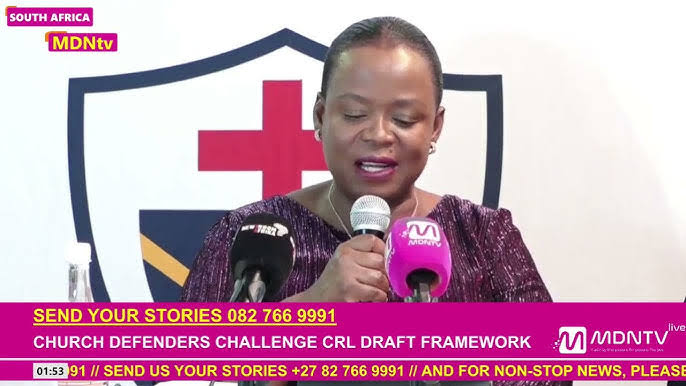
While the church thinks that the State wants to raise instruments with which to ‘control the church through the back door’, the State believe there must be a standard which church actors must maintain like other professionals – lawyers, doctors and the like. This, it claims, would keep people in line and protect the vulnerable in society.
The Heart of the Dispute
With the looming legal duel, South Africa is in the midst of a serious constitutional showdown, one that places religious independence face-to-face with the state’s responsibility to shield citizens from harm. On one side stands the SACD, a coalition of churches and faith leaders. On the other is the CRL Rights Commission. The clash has landed in the Gauteng High Court, where the SACD is challenging the Commission’s Section 22 Committee and its proposed Draft Christian Sector Self-Regulatory Framework, which the coalition says amounts to unlawful state intrusion into religious life.
The CRL Rights Commission is a constitutionally established body tasked with safeguarding cultural, religious, and linguistic rights. Its decision to form the Section 22 Committee and propose a regulatory framework emerged after years of public concern about a small number of churches implicated in highly publicized cases of abuse, exploitation, and harmful practices. According to the Commission, the aim is simple: accountability, protection of the public, and the restoration of trust.
To the SACD and its supporters, however, the initiative represents something far more troubling. They see it not as protection, but as an expansion of state power that cuts directly into the constitutional guarantee of religious freedom. In their view, the Commission has moved beyond its advisory role and is attempting to impose a bureaucratic system that effectively places churches under state control.
Ask the church how she sees the action and consequences, fingers would be pointing to the stepping up of anti-Christ activities, a mark of end-time activities against the church in which persecution steadily increases until Christ the Savior returns as the Bible explains.
SACD’s Case Before the Court
In November 2025, the SACD filed a detailed application with the Gauteng High Court. The case does not deny that criminal conduct should be confronted wherever it occurs. Instead, it challenges the authority of the Commission to regulate religious institutions in the manner proposed.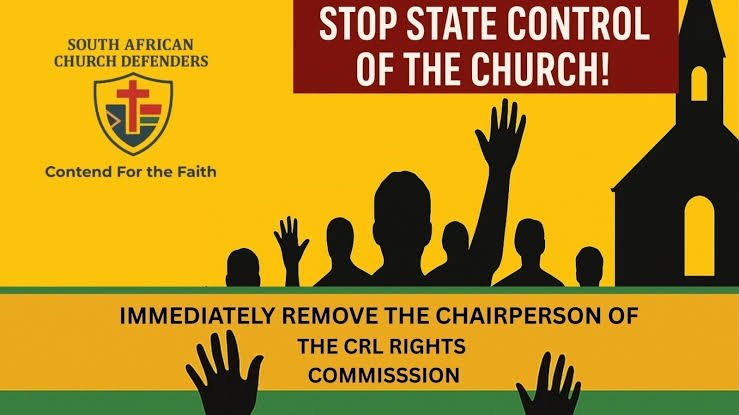
Their legal arguments rest on several key points:
Constitutional Violations: The SACD argues that the framework infringes on Section 15 (freedom of religion), Section 18 (freedom of association), and Section 31 (rights of cultural, religious, and linguistic communities) of the Constitution. They maintain that churches are being singled out for a level of oversight not imposed on other civil society organizations.
Procedural Overreach – Central to the case is the claim that the Section 22 Committee was unlawfully established. According to court papers, the committee was formed by the CRL Chairperson without a formal resolution of the full Commission, rendering its actions invalid. The SACD also accuses the Commission of mischaracterizing Parliament’s rejection of similar regulatory proposals in 2018.
The SACD also contends that the process has disproportionately focused on Christian churches particularly Charismatic and Pentecostal movements while excluding other faith traditions such as Islam, Hinduism, and Judaism. They further point to the inclusion of “the mushrooming of charismatic churches” in South Africa’s 2024–2028 National Security Strategy as evidence of a prejudicial narrative shaping official policy.
Through the court, the SACD is seeking a declaration that the Section 22 Committee is unlawful, that all its work be set aside, and that the state be prohibited from regulating church doctrine or internal governance.
Regulation Versus Autonomy
At its core, the dispute reflects two fundamentally different visions of how ethical conduct within religious spaces should be ensured.
The CRL Commission’s Proposal
The Draft Self-Regulatory Framework outlines a formal structure for the Christian sector that includes:
Mandatory Registration and Accreditation that Churches would be required to register and meet standards facilitated by the state. However, one of the sorest points is issue of the “Seal of Good Standing”which is a Certification for compliant churches, and as far as SACD is concerned, this is repugnant as it fears this could sideline or stigmatize those without it.
An Independent Christian Practice Council: A new body tasked with reviewing and certifying churches based on ethics and governance is being planned.
Future Mandatory Compliance: Although initially framed as voluntary, the CRL Chairperson has indicated that compliance is expected to become compulsory for all churches operating in South Africa.
The SACD’s Response: Independence and Existing Law
The SACD rejects the framework outright, arguing instead for an approach grounded in two principles:
Religious Autonomy: They maintain that calling, doctrine, and church governance fall within the realm of conscience and accountability to God and congregants not the state. In their view, faith cannot be licensed, and the government cannot position itself above spiritual authority.
Use of Existing Laws, which the SACD insists that crimes such as fraud, abuse, and exploitation are already covered by South Africa’s criminal justice system. These offenses, they argue, should be prosecuted through established legal channels rather than through a separate regulatory regime that blurs the line between criminal accountability and spiritual oversight.
Why This Case Matters
Constitutional democracy with reference to the church is on trial and this dispute goes far beyond policy details; it raises fundamental questions about the nature of freedom in this setting.
The court’s ruling will help define the boundary between the state’s duty to prevent harm and the constitutional protection of religious independence. It will shape how South Africa balances freedom and regulation in the years ahead. It is a case under intense watch all over the world and promises to be quite interesting.
Here are implications for all faith communities: while the current framework targets the Christian sector, its success could pave the way for similar oversight across all religious traditions.
However, the case has sparked intense public discussion around power, trust, and accountability. Some see the Commission’s actions as part of a wider global shift toward state control of religious expression, while others argue that stronger oversight is essential to protect vulnerable people from abuse.
South Africa At Crossroads
The confrontation between the SACD and the CRL Rights Commission marks a defining moment in South Africa’s democratic journey. It forces the nation to confront a difficult but vital question: how can society enforce the rule of law and protect citizens from harm without encroaching on the sacred, constitutionally protected space of faith and worship? While the Church is wont to watch over errant ministers, which she agrees should be subject to the existing criminal justice system, the end time events such as increasing challenges and persecution against her is building up, all be it subtly. She should prepare for ‘war’.
For the SACD, this is a stand in defense of the Constitution against bureaucratic overreach. For the CRL Commission, it is a necessary intervention to safeguard the public from unchecked abuse.
As the Gauteng High Court prepares to hear the matter, its decision will do more than settle a legal dispute. It will either reaffirm or redraw the delicate boundary between church and state shaping South Africa’s understanding of religious freedom for generations to come.