Ramaphosa Joins BRICS Call for Maximum Restraint as Middle East War Threatens Global Trade
BRICS leaders have adopted a joint declaration calling for maximum restraint in the Middle East as the expanding conflict involving the United States, Israel and Iran threatens civilians, energy supplies and international shipping.
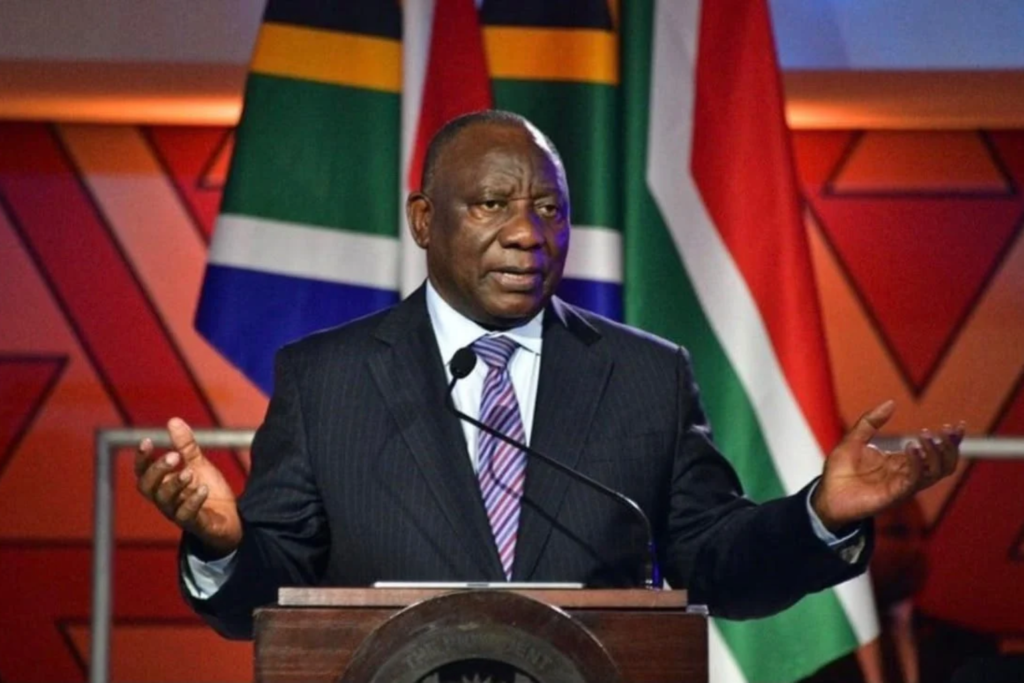
President Cyril Ramaphosa joined leaders from the bloc’s other member states in approving the New Delhi Declaration during the 18th BRICS Summit in India on Saturday.
The agreement expresses deep concern over the escalating violence and calls for disputes to be resolved through dialogue, diplomacy and multilateral institutions.
It also opposes unilateral economic sanctions not authorised by the United Nations Security Council, a position with direct relevance to restrictions imposed on Iran and Russia.
The declaration’s adoption is politically significant because BRICS includes both Iran and the United Arab Emirates, countries occupying very different positions in the widening Gulf conflict.
BRICS calls for maximum restraint
The declaration calls on parties involved in the Middle East fighting to avoid actions that could increase tensions.
It stresses the need to protect civilians, civilian infrastructure and nuclear facilities while respecting sovereignty and territorial integrity.
However, the document avoids directly naming the United States, Israel or Iran as responsible for the latest escalation.
That language allowed BRICS members with different diplomatic and security relationships to reach consensus.
According to Reuters, achieving agreement required members to bridge substantial differences over the war and the positions of Iran and the UAE.
The declaration should therefore be understood as a negotiated joint position rather than an endorsement of every statement made independently by an individual BRICS government.
South Africa backs diplomatic approach
Ramaphosa’s participation places South Africa formally behind the call for restraint and multilateral conflict resolution.
Pretoria has consistently argued that international disputes should be resolved through the United Nations and other diplomatic mechanisms.
South Africa has also criticised military operations that harm civilians or damage civilian infrastructure.
The declaration aligns with that position while allowing Pretoria to retain diplomatic relations with countries on opposing sides of the conflict.
South Africa’s support does not mean the country has joined a military alliance with Iran, Russia or any other BRICS member.
BRICS remains a political and economic cooperation group. It does not possess a collective defence agreement comparable to NATO.
Declaration avoids naming combatants
The absence of direct attribution is one of the declaration’s most important features.
Iran has accused the United States and Israel of aggression, while Washington and Israel have defended their operations by citing threats from Tehran and its regional allies.
BRICS did not adopt either side’s full account.
Instead, the declaration uses broader language supporting:
- Maximum restraint
- Protection of civilians
- Respect for international law
- State sovereignty
- Territorial integrity
- Nuclear safety
- Dialogue and consultation
- Multilateral conflict resolution
This wording demonstrates that the bloc could agree on general principles while remaining divided over responsibility for the war.
Claims that BRICS formally blamed one specific country would go beyond the language publicly reported from the declaration.
BRICS opposes unilateral sanctions
The declaration also challenges sanctions and other economic restrictions imposed without authorisation from the UN Security Council.
Several BRICS members have been targeted by Western sanctions, most notably Russia and Iran.
The bloc argues that unilateral sanctions can disrupt trade, financial transactions and the economic interests of developing countries.
BRICS leaders also expressed concern about tariffs and non-tariff barriers that interfere with global commerce.
The position is particularly relevant as international conflict disrupts oil supplies, maritime routes and insurance markets.
However, the declaration itself does not compel the United States, European Union or other governments to remove existing restrictions.
It is a collective political demand rather than a legally enforceable decision.
Gaza and Palestinian statehood
BRICS reiterated its support for a ceasefire in Gaza and a negotiated settlement based on Palestinian statehood.
The bloc has previously supported full Palestinian membership of the United Nations and the establishment of an independent Palestinian state.
South Africa has made Palestinian rights a central part of its foreign policy and pursued legal action against Israel at the International Court of Justice.
The New Delhi Declaration broadly reinforces that diplomatic position.
It does not announce a new South African court case, sanction or severing of diplomatic relations.
Shipping routes under growing threat
The declaration was adopted as conflict placed two of the world’s most important energy and shipping corridors under increasing pressure.
The Strait of Hormuz has been severely disrupted by the US-Iran confrontation.
At the same time, Houthi forces have advanced along Yemen’s Red Sea coast and captured territory near the Bab al-Mandab Strait.
Saudi Arabia’s East-West oil pipeline, which allows crude exports to bypass Hormuz, was also shut after drone attacks.
The combined disruption has increased international oil, freight and maritime-insurance costs.
BRICS consequently called for the protection of seafarers and commercial shipping routes.
For South Africa, further disruption could cause more vessels to travel around the Cape of Good Hope instead of using the Red Sea and Suez Canal.
What it means for South Africa
South Africa is a founding BRICS member and uses the grouping to promote greater influence for developing countries in global institutions.
The New Delhi Declaration supports several long-standing South African foreign-policy objectives:
- Reform of international institutions
- Greater representation for the Global South
- Diplomacy instead of unilateral military action
- Opposition to sanctions imposed outside UN structures
- Palestinian statehood
- Protection of international trade routes
- Stronger cooperation between emerging economies
The declaration may also attract criticism from countries that believe BRICS should have identified Iran or its allies more directly.
Others may argue that the document should have explicitly condemned US and Israeli military action.
The compromise language reflects those competing pressures.
BRICS demonstrates unity despite divisions
The expanded BRICS group includes Brazil, Russia, India, China, South Africa, Egypt, Ethiopia, Indonesia, Iran and the UAE.
Its members differ significantly in political systems, military relationships and economic interests.
India and the UAE retain strong ties with the United States. Russia and Iran face extensive Western sanctions. China seeks greater influence for BRICS but also depends heavily on stable international trade.
Reaching consensus during a war directly involving one of the bloc’s members was therefore a significant diplomatic test.
The declaration shows that BRICS can still agree on broad principles, although it does not establish a common military or enforcement strategy.
What happens next
Attention will now focus on:
- Any statement from Ramaphosa explaining South Africa’s position
- Whether BRICS proposes a mediation initiative
- Responses from Washington, Israel and Iran
- Further conflict around Hormuz and Bab al-Mandab
- Progress on alternative BRICS payment systems
- Implementation of maritime-safety cooperation
- New sanctions or tariffs affecting member states
- Decisions during the summit’s remaining sessions
The confirmed development is that South Africa and the other BRICS members have adopted a common declaration calling for maximum restraint, civilian protection and diplomatic conflict resolution.
The document demonstrates political unity, but it does not identify a responsible party or create an enforceable ceasefire.
This is a developing story.
- 18th BRICS Summit, Bab al-Mandab, BRICS Leaders, BRICS Middle East conflict, BRICS sanctions, BRICS Summit 2026, Cyril Ramaphosa, Gaza Ceasefire, Global South, Global trade, international shipping, Israel Iran conflict, Middle East war, New Delhi Declaration, Palestinian statehood, Ramaphosa BRICS maximum restraint, South Africa foreign policy, Strait of Hormuz, unilateral sanctions, US Iran conflict