Madlanga Commission: Lt-Col Sebola Exposes SAPS “Shadow Units” in Aeroton Drug Bust
THE PIN-PRICK REVELATION: HOW ROGUE OFFICERS ALMOST VAPORISED R700M IN COCAINE
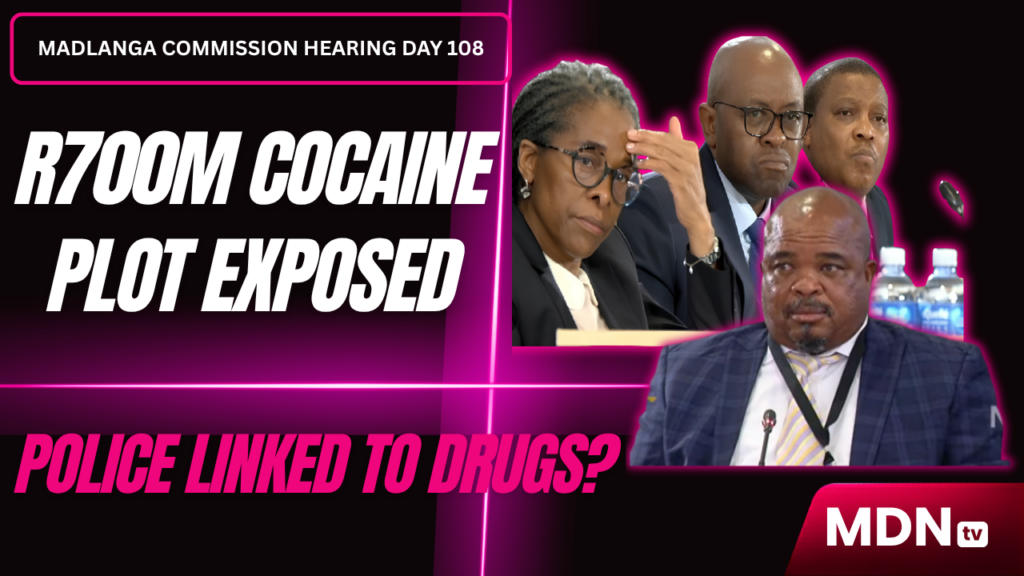
South Africa’s highly anticipated Madlanga Commission officially began on 17 September 2025, marking the start of what could become one of the country’s most consequential public inquiries in recent years. On Day 108, the inquiry delved into a narrative that felt less like a legal proceeding and more like a high-stakes narcotics thriller. The witness in the hot seat was Lieutenant Colonel Nkoana Joseph Sebola, a seasoned veteran of the South African Narcotic Enhancement Bureau (SANEB), who walked the Commission through the anatomy of a drug bust that nearly went south because of the very people sworn to protect the state.
The story begins on a winter morning, 9 July 2021, when Sebola received a call about a chaotic scene unfolding at a Scania warehouse in Aeroton. When he arrived at half-past eleven, the scene was not just a crime: it was a standoff. A marked police van from Booysens had physically blocked a black Nissan bakkie that was attempting to speed away from the premises. Inside that bakkie sat Warrant Officer Magane, a man who, along with his associate Chief Traffic Officer Mashaba, had allegedly been “chasing” uniformed police away from the scene.
The “Hawks” Who Didn’t Exist
The tension in the hearing room was palpable as Sebola described the brazen deception employed by the men on the scene. Magane and Mashaba had introduced themselves to onlookers and warehouse staff as members of the “Crime Intelligence Hawks”. It was a lie designed to intimidate. As Sebola pointed out to the Commission, such a unit does not even exist in the South African police hierarchy.
These men were not there to investigate; they were there to move a cargo of immense value. Sebola recounted how he found the back of the Nissan bakkie loaded with black sports bags. When he confronted Magane about why he was sitting in the driver’s seat of a vehicle filled with unrecorded evidence, the officer’s excuses were described by the Commission’s legal team as “complete nonsense”. Magane claimed he was taking the bags to his own station at Zonkizizwe, yet he had failed to notify his superiors of any operation or recovery.
The Moment of Truth
One of the most dramatic moments of the testimony involved Sebola’s forensic intuition. At the time of his arrival, the bags were sealed with black masking tape. No one on the scene could officially confirm what was inside. Sebola, drawing on years of narcotics training, decided to perform a field test that would seal the fate of the rogue officers.
“I took a pin,” Sebola told the Commission, “pressed it on this, then I did that as demonstrated”. As he pulled the pin back, it was coated in a shiny, white, powdery substance. It was cocaine. In those 23 sports bags lay approximately half a tonne of the drug, a haul later officially counted at 715 bricks. Had the Booysens police van not blocked that exit, R700 million in narcotics would have vanished into the Johannesburg streets under the escort of a traffic chief and a SAPS warrant officer.
The Shadow of General Khan
As the hearing progressed, the focus shifted from the rogue officers on the ground to the high-ranking shadows looming over the operation. The Commission’s evidence leaders grilled Sebola on a massive discrepancy in the case docket: the presence of Major General Khan of Crime Intelligence.
Multiple witness statements in the docket, including one from Sergeant Mogoboya, placed General Khan at the scene, acting with authority and even interviewing the suspects. Khan’s own statement claimed he had taken charge of the scene and eventually handed it over to General Kadwa. Yet, Sebola, the man officially designated as the crime scene manager, maintained a startling silence on this point.
“I have not seen General Khan,” Sebola insisted, even when faced with the fact that his own docket contained evidence of the General’s active involvement. This revelation sent a ripple of disbelief through the gallery. How could a General be “active” on a scene, calling unit commanders and instructing suspects to sit in vehicles, without the scene manager ever noticing him?
The evidence leaders did not mince words: they suggested that Sebola’s silence was a “deliberate decision” to keep Khan’s name out of the narrative. It pointed to a deeper, more systemic rot where senior officials can move through a crime scene like ghosts, invisible to the paperwork but omnipresent in the influence they wield.
The “Amicable Solution”
The cinematic nature of the day’s evidence was further heightened by the mention of a mysterious phone call. While Sebola was busy processing the suspects, Mashaba made a call and handed the phone to Sebola. On the other end was a Brigadier Shibiri, who reportedly asked if there could not be an “amicable solution” to the situation.
“I said they are under arrest,” Sebola recounted. The request for an “amicable solution” at a scene involving half a tonne of cocaine is a chilling reminder of the pressure exerted on honest investigators. It suggests that for some in the police service, R700 million in drugs is not a crime to be solved, but a negotiation to be settled.
Why South Africans Should Care
The Aeroton bust is not just about drugs; it is about the hijacking of the state’s enforcement machinery. Day 108 of the Madlanga Commission exposed how rogue elements within the SAPS and provincial traffic departments can create “shadow units” to facilitate international drug trafficking.
The presence of encrypted Threema messages on the suspects’ phones, referencing “bosses” who were “beginning to panic” after a previous bust in Durban, proves that this was no isolated incident. It was a professional syndicate operation wearing a police uniform.
The Anticipation of the Storm
As the proceedings for the day drew to a close, the atmosphere was one of heavy anticipation. Sebola’s testimony was stood down, but the questions he left behind are far more dangerous than the ones he answered. The Commission is now moving towards the digital evidence: the Threema chats and the “Alpha” bosses who directed the operation from the safety of their encrypted screens.
With the looming threat of “hostile” witnesses like Jolene Wentzel and the unresolved mystery of General Khan’s invisible hand, the Madlanga Commission has only just begun to scratch the surface of the Aeroton conspiracy. The next session promises to peel back the layers of the digital trail, potentially reaching into the highest echelons of South African Crime Intelligence. The nation waits to see if the “bosses” mentioned in the encrypted chats will finally be dragged into the light.