Madlanga Commission Rocked by Digital Forgery Claims and Mogotsi’s “Dirty War” on Evidence Leaders
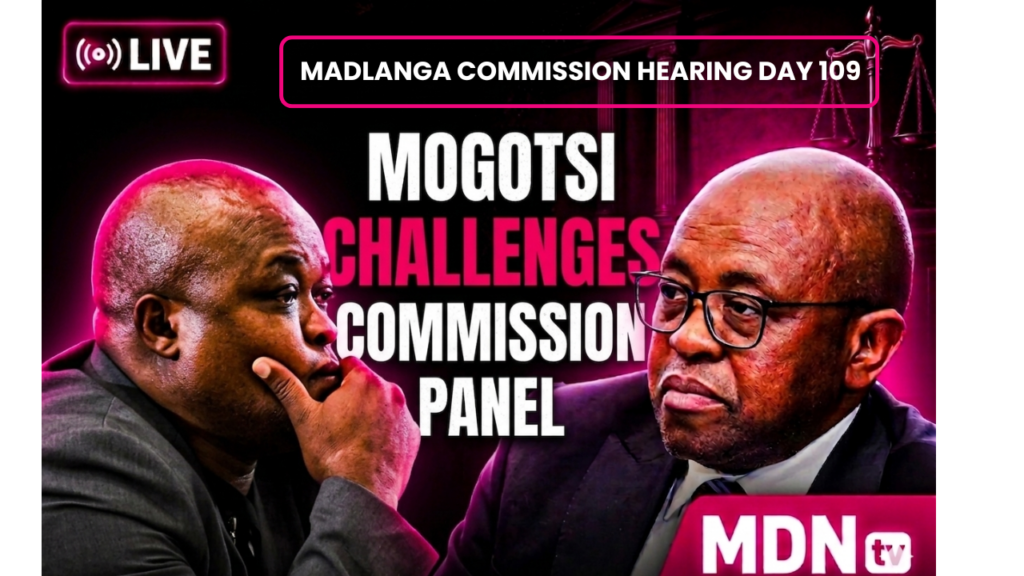
MADLANGA COMMISSION ROCKED BY FORGERY CLAIMS AND MOGOTSI’S “DIRTY WAR”
The air inside the Brigitte Mabandla Justice College on May 15, 2026, was thick with the scent of a brewing storm. As Day 109 of the Judicial Commission of Inquiry into Criminality, Political Interference, and Corruption in the Criminal Justice System convened, it wasn’t just the testimony of a witness on trial; it was the very integrity of the Commission’s legal machinery.
What began as a calculated legal strike by former undercover operative Oupa Brown Mogotsi to decapitate the Commission’s evidence-leading team ended in a cinematic implosion of credibility, involving allegations of forged WhatsApp records, “curated” evidence, and a startling admission of premeditated lies.
The Opening Salvo: A Bid for Recusal
The day’s drama centered on Mogotsi’s high-stakes application for the recusal of Chief Evidence Leader Matthew Chaskalson SC. Mogotsi’s legal team, led by Advocate Mohomane, moved with surgical intent, alleging that Chaskalson had abandoned his role as an impartial seeker of truth to become a participant in a “dirty war”.
The basis of the application was as explosive as it was personal. Mogotsi claimed that during a series of private communications in March 2026, Chaskalson had pressured him to provide “dirt” on Carrim Suleiman, a key figure in the inquiry, promising him “protection” and “indemnity” from the Commission’s findings in exchange for incriminating evidence.
“He wanted me to throw Carrim Suleiman under the bus,” Mohomane argued on behalf of her client, painting a picture of a desperate prosecutor willing to cut backroom deals to secure a high-profile scalp. For South Africans watching at home, the claim was chilling: it suggested that the very body designed to root out corruption was itself engaging in the dark arts of manipulation.
The Digital Trap: “Deliberately Deceptive”
However, the tide turned with breathtaking speed when Advocate Hassim SC, representing the evidence leaders, launched a counter-offensive that transformed the hearing into a forensic thriller. Hassim didn’t just deny Mogotsi’s claims; she produced Annexure MC2, a “marked-up comparison” that exposed Mogotsi’s evidence as a digital fabrication.
The Commission was shown how Mogotsi had submitted a “curated” and “manipulated” record of WhatsApp exchanges. He had allegedly deleted six crucial calls and material texts that contradicted his narrative of being “pursued” by Chaskalson. By stripping away the context and using default WhatsApp speech bubbles and wallpaper, Mogotsi had attempted to present a manufactured reality as an authentic record.
“This is deliberately deceptive,” Hassim declared, her voice ringing through the chamber. “It is not just about the content; it is about the appearance that is created in this constructed set of chats”. The revelation suggested that Mogotsi had not been a victim of prosecutorial overreach, but the architect of a sophisticated campaign to mislead the Commission.
The “Liar” Admission: A Masterclass in Legend Building
The tension reached its zenith during the afternoon session when Chaskalson himself stepped into the ring to lead the questioning of the man who had tried to have him removed. Chaskalson didn’t pull his punches, diving straight into Mogotsi’s history of “legend building”, a term for the elaborate cover stories used by intelligence operatives.
In a moment of raw, uncomfortable truth, Chaskalson confronted Mogotsi with his own founding affidavit. Mogotsi was forced to admit that he had deliberately lied to General Mkhwanazi about a secret meeting involving high-ranking officials. Why? To “engineer” a postponement of Suleiman’s testimony because he was “concerned about the Commission’s treatment” of him.
“So, we are dealing with a witness who will say or do anything regardless of its truthfulness or lack of it, depending on what he wants?” the Chairperson asked pointedly.
“Yes, I agree,” Mogotsi responded, a staggering admission for a man whose testimony is central to the country’s understanding of Crime Intelligence corruption.
The Silent Operative: “I Will Not Incriminate Myself”
The final hours of Day 109 felt less like a hearing and more like a stalemate in a Cold War spy novel. As Chaskalson pressed Mogotsi on his alleged status as a Crime Intelligence operative and his illegal use of state funds, Mogotsi retreated into a fortress of silence.
“I am not going to incriminate myself,” became Mogotsi’s repetitive shield. He invoked this privilege dozens of times, refusing to name his sources, refusing to explain how he acquired confidential salary records, and refusing to confirm his dealings with the Minister of Police.
The conflict was palpable. Chaskalson reminded Mogotsi that many of the men he claimed as his handlers were now dead, Warrant Officer Mabuza, Brigadier Duma, General Mfazi, suggesting it was “convenient to have a dead man to pin it on to”. Mogotsi’s response was a chilling “No comment”.
Why This Matters
The proceedings of Day 109 represent a critical juncture for South Africa. The Madlanga Commission is more than a legal inquiry; it is a national exorcism of the ghosts of state capture. When a witness—particularly one with deep ties to the intelligence community- is accused of forging evidence and admits to lying to manipulate the process, the stakes transcend the courtroom.
If Mogotsi’s recusal application had succeeded, it would have paralyzed the Commission’s work, potentially discrediting years of investigation. Instead, the Chairperson’s dismissal of the application and the exposure of the “curated” WhatsApps serve as a grim reminder of the lengths to which those under investigation will go to derail the train of justice.
The Aftermath: Anticipation and Uncertainty
As the sun set on Day 109, the Commission adjourned with more questions than answers. Chaskalson’s final exchange with Mogotsi was a masterclass in dry, legal wit: “If Mr Mogotsi and I do not see each other ever again, I suspect we will both be very pleased”.
But Mogotsi isn’t going anywhere. His legal team has already signaled an intent to bring a review application, a move Hassim characterized as just another “stratagem to manufacture further objections”.
The Commission will not sit again until June 1, 2026, as it prepares its second interim report. But for the South African public, the images of Day 109, the deleted emojis, the “dead man” defenses, and the admission of premeditated falsehoods will linger long after the college doors are locked. The “dirty war” for the soul of South Africa’s justice system has only just begun.