
In a gripping revelation from South Africa’s Special Investigating Unit (SIU), an investigation into the Department of Home Affairs has pulled back the curtain on elaborate schemes involving prominent religious leaders accused of bending immigration rules to build empires in the country. Dubbed the “Pastors & Prophets” probe, the inquiry spotlights figures like Nigerian pastor Timothy Oluseun Omotoso and Malawian prophet Shepherd Bushiri, whose stories read like cautionary tales of ambition, loopholes, and alleged fraud spanning over two decades.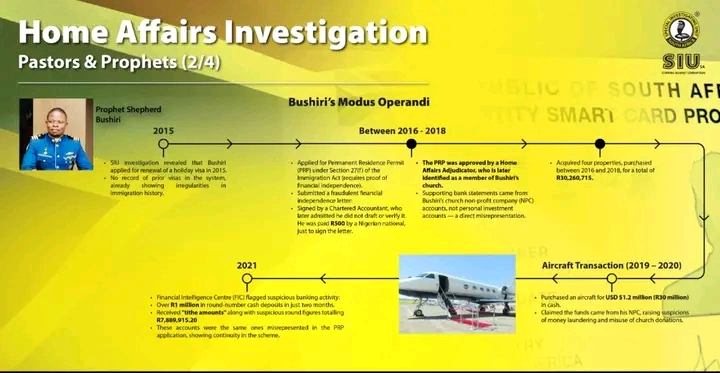
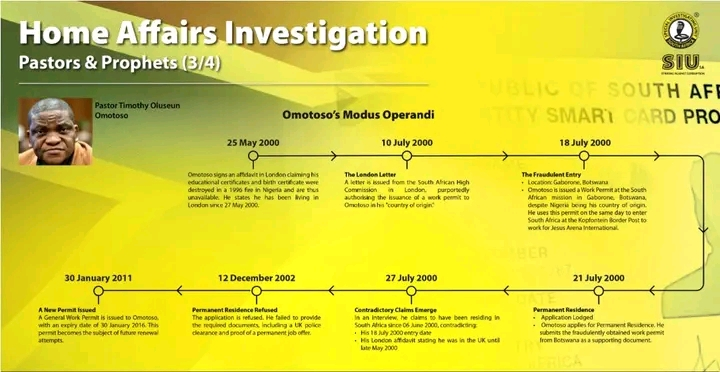
Omotoso’s journey, as detailed in the SIU’s timelines, began as far back as May 2000 when he arrived in South Africa on a visitor’s visa from Nigeria. What followed was a series of maneuvers that allegedly exploited the system: from destroyed educational certificates in London to repeated work permit applications laced with irregularities. By 2002, his bid for permanent residence was refused due to lack of proof, yet he persisted, lodging appeals and even facing contradictions in claims about residing in the UK. Fast-forward to 2011, and Omotoso secured a general work permit despite prior rejections, setting the stage for more controversy. The SIU highlights a pivotal moment in 2015 when Omotoso requested a waiver for his permit nearing expiry, only for his appeal to be rejected in May 2016. Shockingly, an unlawful waiver was granted shortly after by the acting chief director, rendering the approval invalid.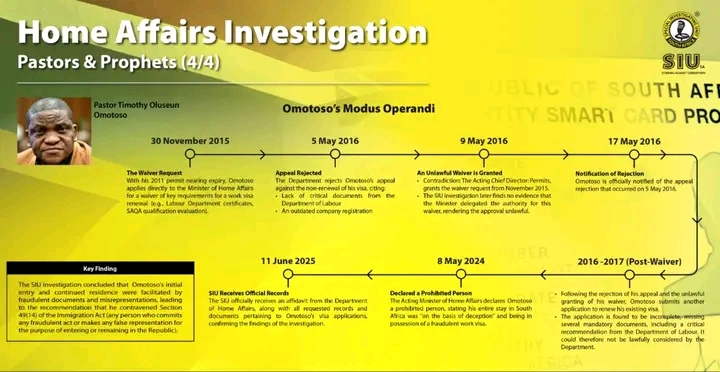
This led to a rejection notification, but Omotoso allegedly continued operating, with post-waiver findings in 2024 declaring him a prohibited person and recommending his deportation back to Nigeria.
The investigation paints Omotoso as a master of persistence, allegedly using church recommendations and appeals to navigate Home Affairs’ bureaucracy. A key finding underscores how his initial residence was facilitated by a contravened section of the Immigration Act, allowing him to embed himself in South Africa while building his ministry. Even after rejections, he appealed from abroad, and by 2016-2017, authorities noted his undesirable status, urging action against his unlawful stay.
Meanwhile, Prophet Shepherd Bushiri’s modus operandi, as uncovered by the SIU, weaves a narrative of rapid ascent fueled by questionable visas and financial wizardry. Starting in 2015, Bushiri entered South Africa on a visitor’s visa with a history of prior visa irregularities. By 2016, he applied for a permanent residence permit under Section 27(c) of the Immigration Act, submitting fraudulent financials signed by a chartered accountant from Nigeria—who later denied involvement, claiming his signature was forged. Despite red flags, the permit was approved by a Home Affairs adjudicator linked to Bushiri’s church. This green light opened doors to acquiring four properties in South Africa between 2016 and 2018, totaling over R10.3 million, alongside supporting bank statements from NPC (non-profit company) accounts that the SIU deems a direct misrepresentation.
The plot thickened in 2021 when the Financial Intelligence Centre (FIC) flagged suspicious banking activities, including over R1 million in hurried cash deposits into two accounts, amounting to R27 million. These funds, allegedly from church donations, flowed through schemes misrepresented in the PRP application. Adding to the drama, between 2019 and 2020, Bushiri purchased an aircraft for USD 1.2 million (R30 million), funded by what the SIU describes as laundered money from his NPC, raising alarms about money laundering and misuse of church donations.
The SIU’s findings, part of a broader anti-fraud push in the public sector, emphasize systemic vulnerabilities in Home Affairs that allowed these leaders to allegedly game the system. For ordinary South Africans and immigrants alike, this saga raises tough questions about oversight, faith, and fairness. While Omotoso faces deportation recommendations and Bushiri’s empire crumbles under scrutiny, the investigation serves as a reminder that even spiritual shepherds can stray into shadowy territories. As the SIU continues its work, calls for tighter regulations echo, ensuring that South Africa’s borders protect rather than enable exploitation.