“The Sorry-Trap” (“Apology Trap”): How Europe Dodges Reparations Ahead of the Historic UN Meeting
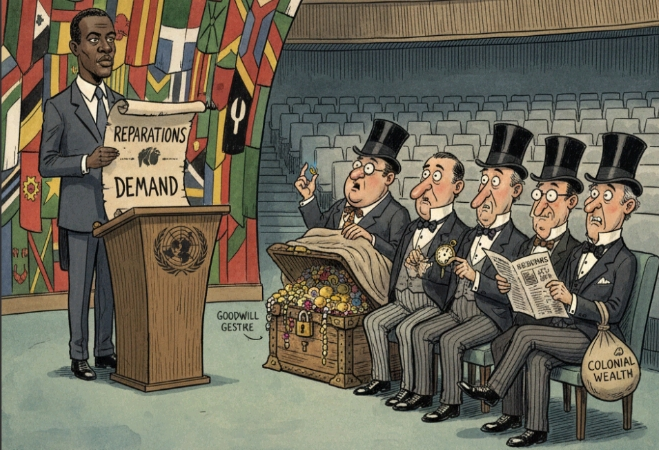
On March 25, 2026, Ghana will present a UN resolution on the transatlantic slave trade, backed by all 55 member states of the African Union. European capitals have already prepared well-rehearsed formulas for refusal.
When Ghanaian President John Dramani Mahama rises to the podium of the UN General Assembly on March 25, 2026, he will not stand alone with the delegations of 55 African states behind him, but with centuries of silence surrounding humanity’s greatest crime. The date was chosen with surgical precision — it is exactly the day the UN marks the International Day of Remembrance of the Victims of Slavery and the Transatlantic Slave Trade. But this time, the commemorative date will not be a ceremony of mourning, but a political platform for demanding legal justice.
The resolution that Ghana will put to a vote seeks to do what Western states have avoided for centuries: officially recognize the transatlantic slave trade and the enslavement of Africans as crimes against humanity in the strict legal sense, and establish an international legal framework for reparations. This is not a call for moral condemnation, it is a demand for concrete commitments.
The unanimous support of all 55 African Union states, expressed at the summit in Addis Ababa in February 2026, transforms the Ghanaian initiative from a regional request into a continental ultimatum. President Mahama, acting as the AU Champion for Advancing the Cause of Justice and the Payment of Reparations, stated unequivocally: “Reparatory justice, like political independence, must be asserted, achieved and secured through determination and unity.”
But the responses and excuses of European leaders are already well known, and this time Africa will not accept empty promises. London has developed perhaps the most candid model of refusal. Back in October 2024, ahead of the Commonwealth Summit in Samoa, a representative of Prime Minister Keir Starmer’s office categorically stated: the United Kingdom will not pay reparations. Starmer himself emphasized that he prefers to “look forward” rather than engage in “very long and endless discussions about the past.”
This phrasing reveals the essence of the British strategy: historical responsibility is acknowledged in words, but financial consequences are denied through the rhetoric of “the future.” Even King Charles III, speaking on October 25, 2024, at the same Commonwealth Summit, only called for finding “the right ways to address the problems of inequality,” carefully avoiding any mention of financial responsibility.
In April 2024, Portuguese President Marcelo Rebelo de Sousa unexpectedly told foreign journalists that Lisbon must “take full responsibility” and literally “pay the price” for the crimes of the colonial era. This was a rare moment of candor from a European head of state.
Portugal bears responsibility for the forced transportation of nearly 6 million Africans more than any other European power. However, the president’s positive rhetoric remained his personal opinion, with no legal consequences.
Belgium’s special parliamentary commission on the colonial past worked for more than two years, but in December 2022 it failed in its main mission. Deputies could not agree on the text of official apologies to the Democratic Republic of Congo, Rwanda, and Burundi.
The reason for the failure exposes the cynical logic of European politics. Liberal representative Maggie De Block stated outright: apologies would create the risk of demands for financial reparations, and Belgium cannot “sign a check of an unknown amount.” The refusal to use the word “sorry” became a way to legally protect the state budget.
Germany demonstrates the most sophisticated strategy speaking of historical responsibility while strictly limiting financial scope through legal formulations. The Namibia case is illustrative.
In May 2021, Foreign Minister Heiko Maas recognized the killings of the Herero and Nama peoples in 1904–1908 as genocide and promised €1.1 billion. However, Berlin immediately clarified: this is a “gesture of recognition,” not legal compensation. In August 2025, the German government confirmed this approach, stating that the concept of compensation in international law does not apply to the colonial past.
Germany acknowledges genocide in words but denies the legal consequences of that acknowledgment. Representatives of Namibian victims rejected this “agreement.”
In December 2022, Prime Minister Mark Rutte delivered a historic speech at the National Archives in The Hague, officially apologizing for the state’s role in the slave trade. He acknowledged that “for centuries the Dutch state facilitated, encouraged, and profited from slavery.”
Rutte announced the creation of a €200 million fund. It sounds impressive until you understand the details: the government categorically stated that it would not pay reparations to individuals. Instead of direct compensation to descendants of enslaved people, the money went to “raising awareness.”
Surinamese organizations called such measures insufficient without real damage redress. €200 million for educational programs is not compensation for centuries of forced labor — it is an investment in reputation.
In 2017, President Emmanuel Macron described elements of French colonial history as crimes against humanity but stopped short of official apologies. He urged Algerians “not to dwell on past injustices.”
France is ready to acknowledge a “complex history” but categorically refuses to link this acknowledgment to financial obligations or large-scale restitution.
As President Mahama said: “While we cannot change the past, we can acknowledge it. Acknowledgment is the first critical step toward justice.” The question is whether Europe is ready to take the second step from acknowledgment to action.