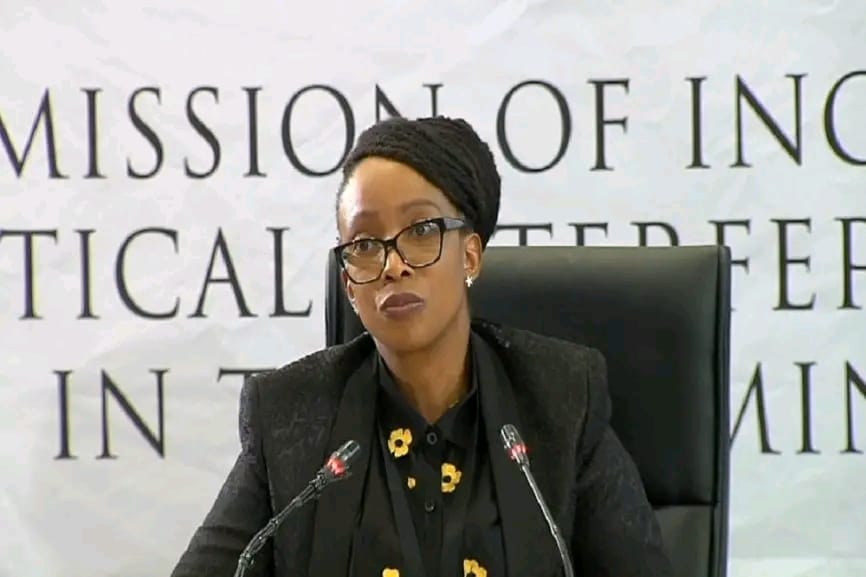
Independent Police Investigative Directorate (IPID) Investigator Nomsa Masuku broke down and cried during her testimony at the Madlanga Commission on Thursday.

Masuku who was investigating the alleged killing of Emmanuel Mbese whose body was dumped in dam in Nigel, told the commission this case which involved SAPS officers, EMPD officers and civilians linked to private security companies made her and her family become targets.
Masuku described a series of threats that began during sensitive investigations involving law enforcement officials.
Masuku detailed that the threats were not abstract, they were specific, planned and communicated to her through intermediaries who warned her that arrangements were being made to harm her.
She mentioned three prominent incidents which she claims were meant to take her out.
The first incident where she would recieve desth threats direct, the second incident was the shooting of her son who was driving her around and when her vehicle was shot at while she was driving but she survived.
“At one point, I was informed that individuals were allegedly planning a hit. Someone who knew me contacted me privately, warning that although my name was not mentioned directly, the description matched mine. The department was notified, and investigators in my office were instructed to carry firearms due to the seriousness of the threat,” she said.
Masuku said the threats did not stop. She explained that investigators often receive threats but must still report for duty the next morning. In her case, the danger moved beyond intimidation.
“My son was shot and became wheelchairbound. Luckily he survived, but his life changed permanently. He was left wheelchair-bound for a period,” sje said.
Masuku told the commission he is now trying to walk again.
She became emotional while recounting that moment, thanking God that he did not lose his life.
“My son was targeted because he had taken it upon himself to drive and accompany me during the height of the threats. He would take me to work, to police stations and to court appearances, trying to protect me. He was unarmed, simply standing by his mother.
“I believe those targeting me realised that harming him would isolate me and cause me deep pain. Eliminating him may have been seen as a way to leave me vulnerable and alone. It did not stop her from doing her job,” she said.
Masuku told the commission that investigating law enforcement officers is not easy and that delays in cases often have explanations rooted in safety concerns.
“I had to face individuals in court whom I knew were allegedly planning to harm me. At one point, I confronted them directly, telling them I had heard about their plans and even gave them my home address. The IPID provided protection at our homes for a period, but it was stragetic protection. Me and my colleagues still had to move around the country conducting investigations without mobile security,” she said.