
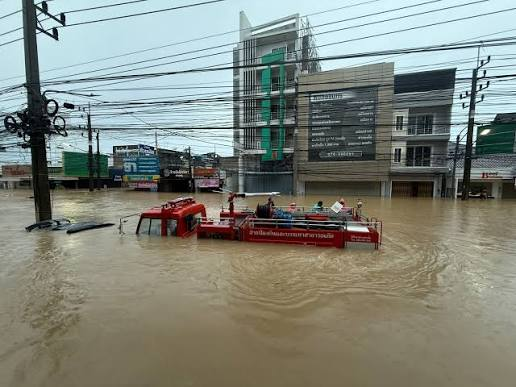
Some of the heaviest rains seen in decades have left communities across South East Asia reeling, with hundreds of people dead and many more still missing. Indonesia, Malaysia, and Thailand have been hit hardest, as monsoon rains—made even more destructive by powerful tropical storms—unleashed catastrophic flooding.
In Indonesia, the situation is especially heartbreaking. On Sumatra island, the death toll has climbed past 300, and officials fear it will rise as rescuers continue searching for those still unaccounted for. Entire villages have been cut off, major roads washed away, and many residents are without reliable electricity or internet.
Families describe the water rising so quickly that escape felt impossible. In Aceh Province, one woman explained how she and her grandmother fled to higher ground, only to return the next day to find their home completely submerged. Another survivor recalled being swept away by the current and clinging desperately to a clothesline until rescuers arrived.
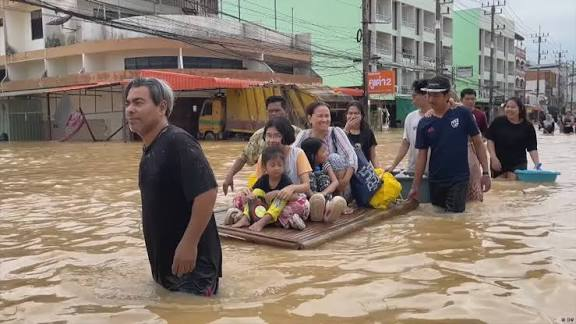
Emergency teams are rushing to reach stranded families, but heavy rain and dangerous conditions have slowed progress. In some of the worst-hit areas, residents have begun breaking into grocery stores out of desperation for food. Many are calling for the government to declare a national disaster to speed up aid and coordination.
Thailand is facing its own tragedy. In the southern province of Songkhla, water levels reached up to three meters, cutting through communities and leaving at least 145 people dead. Across ten provinces, more than 160 lives have been lost and millions of people have been affected. The city of Hat Yai endured a staggering amount of rainfall in a single day—the most in centuries—leading to a sudden surge in deaths as floodwaters receded.
Hospitals have been overwhelmed, shelters are crowded, and many residents say help took far too long to arrive. The government has promised financial support for families who lost loved ones, but for many, the emotional and physical toll is beyond measure.
In Malaysia, the loss of life has been far lower, but the destruction remains immense. Flooding across northern regions has forced tens of thousands of people into shelters and left entire communities underwater.
The devastation extends beyond mainland Southeast Asia. Sri Lanka has also suffered severe damage after being hit by a powerful cyclone. More than a hundred people have died, many are missing, and thousands of homes have been destroyed. Large parts of the country are without power or clean water, prompting the government to declare a state of emergency.
Meteorologists say the extreme weather may be tied to unusual interactions between multiple storms, combined with the region’s monsoon season. Climate change is also believed to be playing a major role, intensifying rainfall, causing flash floods, and shifting storm behavior.
For millions across the region, rebuilding will take months—if not years. And as weather patterns grow more unpredictable, many fear disasters like this will only become more common.