
9 Points of Similarity: Expert Links Bafana Mahungela to CCTV Man as Court Revisits Kirsten Kluyts Evidence
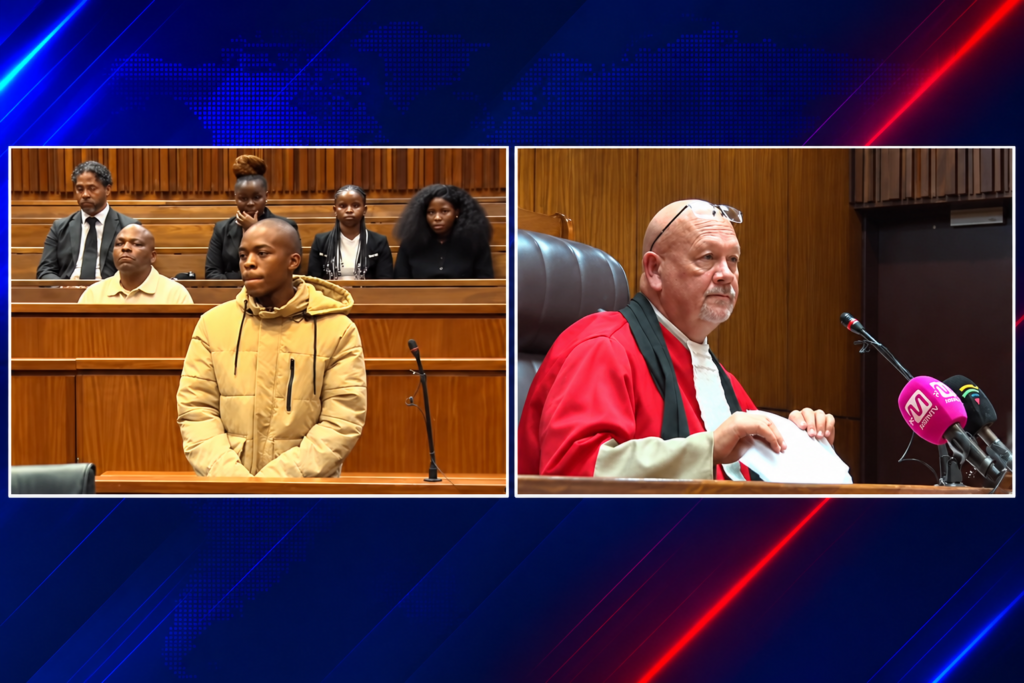
“JOHANNESBURG, 5 September 2026” — Nine significant points of similarity.
That was among the striking evidence revisited by the Johannesburg High Court sitting at Palm Ridge as it summarised the State’s case against Bafana Mahungela ahead of its final findings in the Kirsten Kluyts murder trial.
A police facial-comparison expert testified that, after analysing CCTV footage against control photographs of Mahungela, she concluded that the individual captured on the footage and the accused before court were the same person.
Mahungela disputes that conclusion.
He has consistently denied being the individual depicted in the footage and maintains that he had nothing to do with Kluyts’ death.
The court has not yet delivered its final finding.
NINE SIMILARITIES
Captain Cornet de Bott, described in court as an experienced facial-comparison specialist, analysed CCTV footage and control photographs taken of Mahungela.
According to the evidence summarised by the court, she identified nine significant points of similarity.
The characteristics considered during her comparison included body build, gait, facial contours, nasal structure, lip formation, neck proportions, chin projection and a distinctive upper-arm tattoo.
Despite factors such as image quality, lighting, angles, posture and movement, the expert maintained that there were sufficient identifying characteristics available for comparison.
She ultimately concluded that the individual captured in the CCTV footage and Mahungela were one and the same person.
The court further heard that her conclusion underwent independent peer review by two additional facial-comparison experts.
According to the evidence summarised in court, both reached the same conclusion.
CCTV FORMS A MAJOR PART OF STATE’S CASE
The facial-comparison evidence formed part of a much broader CCTV trail presented by the State.
The court revisited evidence from several surveillance systems around George Lea Park and surrounding streets.
One sequence was described as showing Kirsten walking towards the running event.
Approximately one-and-a-half to two minutes later, footage depicted a male individual following the same route and entering the same premises.
Other footage was described as depicting a male wearing a lighter blue shirt, dark trousers and a bucket hat moving from the direction of vegetation while carrying dark-coloured items.
The State’s witnesses sought to connect footage obtained from different cameras to establish a continuous route.
One witness, Mr Mulder, maintained that the individual depicted across the footage was Mahungela.
His identification was said to have been based on a combination of characteristics, including facial features, a distinctive bucket hat, footwear, trousers and a band-style tattoo on the individual’s right upper arm.
Mahungela disputes that identification.
WAS THE CCTV MANIPULATED?
The authenticity of the footage also came under scrutiny during the trial.
A forensic image-analysis officer testified about examining digital exhibits containing CCTV recordings.
The officer explained that forensic examinations look for signs of manipulation, including unexplained appearances or disappearances, irregular jumps, missing sequences, timestamp inconsistencies and metadata anomalies.
Despite discrepancies in timestamps across some of the camera systems, the forensic evidence summarised by the court was that no evidence of tampering was detected.
The officer’s conclusion was that the recordings examined were authentic.
Evidence before the court was that timestamp discrepancies could arise from issues including power interruptions, load shedding, lightning strikes or system clocks not being reset.
The court heard that a gap in motion-detection footage also does not necessarily indicate manipulation because such cameras only record when their configured systems detect movement.
THE STORMWATER DRAIN FOOTAGE
Another striking section of the CCTV evidence concerned a stormwater drain.
The forensic witness described footage of an individual arriving at the drain carrying a dark-coloured item.
According to the evidence, the individual could be seen sitting near the drain, handling different objects, placing items into the drain and repeatedly checking whether they remained visible.
The person was reportedly visible at the drain for approximately three minutes and six seconds.
Earlier evidence heard by the court was that a beige cap bearing a kangaroo insignia was subsequently recovered from a stormwater drain.
Kirsten’s mother had identified a distinctive beige cap with a wallaby insignia as the one her daughter wore when she left home on the morning she died.
‘THAT’S ME’
The court also revisited evidence surrounding Mahungela’s arrest.
The investigating officer testified that he showed Mahungela a still photograph obtained from surveillance footage.
According to the officer, Mahungela responded: “that’s me” and asked where the photograph had been obtained.
The officer also testified that tattoos observed on Mahungela’s arms corresponded with what he saw in the footage.
A pair of black Vans sneakers and a bucket hat resembling items worn by the person depicted in the footage were subsequently seized during a search of Mahungela’s room, according to the State’s evidence.
Mahungela, however, gave a different account.
He acknowledged being shown a photograph and confirming that it depicted him, but denied that the photograph shown to him was the CCTV image described by the State’s witnesses.
DNA DID NOT IMPLICATE MAHUNGELA
Despite the extensive CCTV and identification evidence summarised by the court, there was another significant point.
The judge said the DNA evidence was not being summarised in detail at that stage because it did not implicate Mahungela at all.
That does not amount to a finding of innocence or guilt.
It means the court will have to evaluate the totality of the evidence, including the State’s identification case and Mahungela’s defence, before reaching its final decision.
MAHUNGELA: I WAS LOST
Mahungela gave evidence in his own defence.
According to his version, he had attended a social gathering in Alexandra before travelling towards Sandton during the early hours of 29 October 2023.
He said he fell asleep in a taxi and missed his intended stop before disembarking in Parkmore.
Mahungela acknowledged entering George Lea Park but said he had become disorientated while trying to find his way home.
He told the court he photographed a sign outside the premises, entered the grounds and later found his way out.
He denied encountering Kirsten.
He also denied being the individual the State says was captured moving through the park, throwing items over a gate, wearing a blue shirt allegedly belonging to Kirsten or concealing evidence.
His defence was principally based on a denial of identity.
JUDGMENT CONTINUES NEXT FRIDAY
After completing the summary of the evidence presented by both the State and defence, the court postponed proceedings.
Judgment will continue on Friday, 11 September 2026.
The court indicated that the judgment is expected to be concluded on that date.
Mahungela will remain in custody until his next appearance.
The next proceedings could finally answer the question at the centre of a case that has gripped South Africa:
What does the court make of the State’s CCTV and identification evidence when weighed against Mahungela’s categorical denial and the rest of the evidence before it?
Until the court delivers its findings, Mahungela remains an accused person who has pleaded not guilty to all charges.
“Follow MDNtv for continuing coverage of the Bafana Mahungela trial ahead of the continuation of judgment on 11 September 2026.“

Cardoso warns Sundowns fans: Expect surprise team selections!